The spirits of the season are a challenged crowd in 'Wonders'
Having rung the changes on the time-honored seasonal bells of Charles Dickens' "Christmas Carol" two years ago, Ben Asaykwee returns to the District Theatre with loftier bells on, starring in a more ambitious original production called "Wonders." With songs and dialogue taking shape often in rhymed couplets, Asaykwee further exercises his creative chops in the allegorical mode. He leaves a parodistic approach to Dickens behind.
I saw the show in a preview Thursday night, finding it full of signs not only wondrous but also grounded in the reality of needing more work. "A Christmas Carol" is brought in obliquely, shedding light on the underlying conflicts that make the transformation of Ebenezer Scrooge so compelling and believable in Dickens' novella and the many stage shows and movies adapted from it.
 |
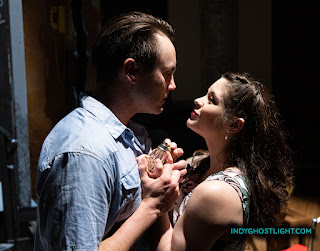
| Hope (Sarah Zimmerman) is indomitable. |
In "Wonders," the emotional conflicts, entailing the moral conflicts to which our emotions contribute so much, are personalized and named in the manner of the 2015 Pixar hit, "Inside Out." Placed in a "pantheon of spirits," Asaykwee has such qualities as Fear, Ambition, Hope, Curiosity, and Avarice facing challenges of working together and acting to express themselves through human agency.
Asaykwee thus paints with a broader brush than "Inside Out," and has undertaken the risk of failing more grandly and even looking slapdash from time to time. He has an unerring sense of how to stage ensemble spectacles, however. Movement, especially through the songs, had dependable vigor despite the preview performance's rough edges. To embody so many aspects of our personalities and fashion a narrative that leans essentially but not too heavily on "A Christmas Carol" seems no small feat. The gift for mythopoeia is not something easily encountered in new musicals, but there it is in "Wonders."
Tbe creative writer himself appears as Truth, a common thread of continuity in what the company of spirits calls "a braid." That Truth needed a text in hand during the preview was an unintended irony, since actual truth lies presumably at some level beyond words on a page. Did the oracle at Delphi have a script? (Asaykwee expects to be off book as the run gets under way; such accidents as two snow days and a national holiday hobbled thorough preparation.)
When the performances were clearly defined and given full dimension in the writing, each Spirit lived up to the single word that labels it. Sometimes the label stood in as a kind of place holder for its embodiment, without much fleshing out.
It makes sense that Fear (Matt Anderson) would be protective of his privileges and proud of their diverse applications. When he makes his way down a long line of white-masked children in one number, for example, he taps each one to identify the particular phobia represented. This is typical of the kind of wit Asaykwee has exhibited ever since his mordant Fringe show "de Sade" –– every generalization must have its particulars, even if distasteful.
Similarly, Pleasure should seem ample in her outreach, and Tiffanie Holifield is unfailingly so, costumed so as to allow nothing unpleasant to touch her, able to radiate good times and good feeling. Even more unalloyed is Joy (Noah Winston), who is mostly given to an open-armed greeting of self-introduction. If Joy is a simpleton, it's hazardous to overthink it.
The ensemble songs generally showed precision in choreography and vocal heft, with the front line leading the way and sensibly earning the audience's focus. The recorded instrumental accompaniment was sometimes too loud in songs designed for one or two singers. Now and then they seemed abruptly concluded, but it might have been part of the plan to show how quickly the ebb and flow of spiritual states proceeds.
Still, Marley was dead to begin with, Asaykwee agrees with Dickens. And Scrooge's fiancee Belle (Michelle Wafford) is prudently warned to give him up to ensure his eventual transformation. No wonder that she can't understand the impact of her decision.
"A Christmas Carol" perpetually holds out its invitation to be loving and merciful. Wondering is what "Wonders" leaves us with, gloriously entertaining as it is: Love and mercy must be struggled for as they rub shoulders with their spirit colleagues.


Comments
Post a Comment