Despite digressions, the song is you: IRT opens "Joe Turner's Come and Gone"
 |
| Seth Holly lets wife and residents know the way things should be. |
The complex verbal music and dark urban rhapsodies of August Wilson carry a variety of appeal to theater companies that can draw upon African-American talent as well as educate and entertain audiences across the racial spectrum, provoking their sense of wonder and highlighting historical truth.
Summed up in the ten plays of the Pittsburgh Cycle, the native son's placing each work in a decade of the 20th century gave an evolving focus to his art, as well as a location he knew intimately: the Steel City's Hill District.
Indiana Repertory Theatre opened a new production of "Joe Turner's Come and Gone" this week, to be shared next month with Syracuse Stage. Along with the Phoenix Theatre, the IRT has a long history with August Wilson shows. In Friday's performance, the strengths and challenges of Wilson's style — verbally flamboyant and thematically spread over a wide swath of Black American history and culture — were evident.
Wilson could barely avoid giving vent through his characters to his understanding of such matters. "Joe Turner's Come and Gone" takes the playwright's rhetorical style and grasp of structure to extremes. Under the direction of Timothy Douglas, the cast creates both vivid and burdensome portrayals of characters whose lives emerge and fade and sometimes glare and shine in boarding-house life.
The setting in 1911 means that memories of slavery and subsequent indignities upon emancipation impress themselves on Black lives. Magical thinking and superstition provide a fertile soil for decisions that skirt rationality and common sense. Racism and the betrayal of the American Dream result in losing track of people as the African-American population stays on the move and finds putting down roots next to impossible. With the action set (by Tony Cisek's design) among a background of steel girders, beams, and joists, the illusion of permanence and the prosperity available to white people in heavy industry puts the marginalized race in deep shadows of exclusion.
The bygone institution of the American boarding house has lent itself to shedding light on how American lives intersect in a temporary setting. The creative response to this pheonomenon can be prolix and sentimental: the American classic novel "Look Homeward, Angel" derives from its author Thomas Wolfe's boarding-house upbringing in Asheville, N.C. There is also ample evidence of authorial curiosity about strangers' lives thrown together in greater or lesser intimacy; in "Bus Stop," playwright William Inge had a 1955 hit linking travelers trapped in a roadside restaurant by a snowstorm.
Wilson's weaving skill in matters of plot and characterization goes beyond the accidental relationships a settled couple manage as they run the establishment with bourgeois aspirations and a contrast of warmth (Bertha) and severity (Seth). I had to wonder how neither is quite at home with the inevitability of getting mixed up in other people's business, since that's essential both in the Hollys' work life and the demands Wilson puts upon himself as a playwright. At least it nurtures continual sparks in the Hollys' relationship and how they deal with the others.
The connection between human and supernatural forces takes the form of the conjure-man Bynum Walker, a confident hoodoo practitioner who serves as a bridge between how the most unsettled characters, mainly the mysterious ex-deacon Herald Loomis, present themselves and the powerful world beneath the surface of life, having the force of myth. He's the fulcrum on which the residents' lives balance uneasily.
He proclaims that link not only by dead-pigeon-and-roots rituals in the yard, but also through his steady insistence that each person has a duty to find his or her song. The play makes its difficult shifts on his emotional and spiritual back, as it were, according to its characters' needs and Bynum's sense of them. The song that Herald Loomis (Shane Taylor, taciturn then explosive) has to move past, definitely not his own, is the play's title. It's an actual folk blues based on a Southern chain gang entrepreneur's way of trapping black lives, making a mockery of their purported freedom.
Thoroughly engaging was DeShawn Harold Mitchell's florid mastery of Bynum, well counterpointed
 |
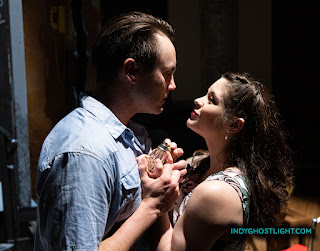
| Jeremy sweet-talks new resident Mattie. |
against Keith Randolph Smith's roaring practicality and toughness as Seth and Bertha's tolerance and feeling for people the way Stephanie Berry played her. Jacques Jean-Mary loaded seductive machismo and pride into the character of the teen Jeremy Furlow, trying to make his way via dull, tentative jobs toward guitar heroism. Kerah Lily Jackson consistently registered the painful search Mattie Campbell is making to find true love.
Love and laughter are what life ought to be based on, Bertha insists at one point. Then she revs up an example of convulsive mirth that has everyone around her laughing. Her speech is an example of several where Wilson, without violating character, seems to have written a kind of set piece, perfect for auditions but, in context, somewhat indulgent. The Wilson plays I've seen often take a swerve into something Wilson wants to say. They illuminate the character somewhat, but they also seem to be an example of fine writing in the Black vernacular.
 |
Selig explains people-finding sideline to Loomis. |
I felt that way in "Fences," the last play in the cycle I saw, when the age-haunted Troy Maxson, a former baseball star, elaborates upon his struggles with Death, lifting them toward mythmaking and near-hallucination. In "Joe Turner's Come and Gone," there are other set pieces besides Bertha's (who normally projects love better than humor, by the way).
Some are designed to deliver bitter irony: Rutherford Selig (cannily played by Peter Bisgaier), the sole white character, enjoys his reputation as a "people finder" and makes good on that in one crucial scene, but oddly shares with us all a family history that includes a slave
trader back in the day. It must be in the genes, don't you know.
How often playwrights go in for this sort of thing! You can find it liberally in Sam Shepard, for instance, heavily through Shaw and even way back in Shakespeare. In "Romeo and Juliet," Mercutio's speech about Queen Mab is so magnificent it has inspired several composers to melodious raptures, even when they haven't bothered to set the words.
The supreme American example of talkiness is Eugene O'Neill, whose characters never seem to speak a phrase that their author hasn't worn to a nubbin with affection. Though I never have seen a stage production of "The Iceman Cometh," long ago I was enthralled by the Lee Marvin movie interpretation of Hickey, the traveling salesman who comes back to a decrepit saloon and lets fly a climactic speech to the barflies that's a bombshell of revelation. It is said to take nineteen minutes in the uncut stage version.
All playwrights find ways to make character entrances and exits plausible, and here Wilson needs to do that to the nth degree to clear the stage of anyone not relevant to the set piece to come. The wheels are always turning, though sometimes the process can be tedious. This powerful drama deserves audiences, but their patience and capacity for absorption is required. You will thrill to the exhibition of the boarding-house's ritual of the ancient juba dance, but it may have to be felt mainly as a relief from all the verbiage.
The key to this hard-to-control verbosity can be found in O'Neill again. Nina, a character in the soliloquy-heavy "Strange Interlude," at one point says "with a strange twisted smile" about the whole human race (the image is not racial):
"How we poor monkeys hide from ourselves behind the sounds called words!"
"Joe Turner's Come and Gone" audiences will be kept busy unveiling the reality behind Wilson's words. Fortunately, the actors in this production help immensely.
[Photos by Zach Rosing]


Comments
Post a Comment