IO's 'The Marriage of Figaro' approaches the perfection of its reputation
Though some of opera's loftiest achievements fit under the genre of tragedy, the art form had to escape the 18th-century strictures of opera seria and set aside ancient gods for sad, stately operas to attract the public's esteem. It's more than sentimentality that reinforces our love for happy endings; it's also the perennial gift of music to raise our spirits uniquely.
Mozart is chief among the examples of comic genius in music, and "The Marriage of Figaro" stands at the summit, partly for skill at illuminating the emotions of real people without overstatement.
Indianapolis Opera opened a production worthy of this masterpiece Friday evening in the Tobias Theater at Newfields. Resourcefully put together from an original production at Northern Lights Music Festival with stage direction here by Jessica Burton, the show has the special advantage of guest conductor Bernard McDonald. Director of Opera at Florida State University, McDonald brings a vast resumé, with Mozart as a subspecialty, to the podium.
 |
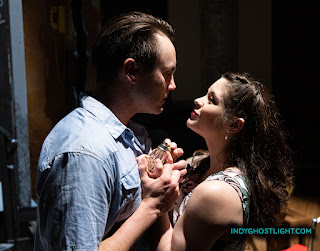
| Countess and newlyweds voice appeal to Count. |
The opening dialogue between the two prospective newlyweds gave Jason Cox as Figaro and Rachel Kobernick as Susanna ample opportunity to show their charms, and they followed suit. The characters have different interpretations of the aims of their boss, the Count Almaviva on whose estate they reside. That guarantees some friction.
The plot will have lots to do with figuring out motivations of the main characters, so their natural inclinations to trust, distrust or scheme their way through inevitably take over. Burton's stage direction consistently made the most of the surprises, quick-thinking responses and adjustments, all supported by the music.
Cox and Kobernick set the tone of the production dramatically and vocally. Solos and ensemble alike made their points clearly, all of course conveyed more intelligibly by sufficient supertitles (translating Lorenzo Da Ponte's libretto). The stalwart projection of Cox's baritone had a heroic cast from the start, which tended to lessen the high polish of cleverness and manipulative cunning Figaro brings to bear on the situations he finds himself in. Still, it was a voice perfect for the resentful passion of "Si vuol ballare" (in which he dances disdainfully with a mannequin representing the Count) and the mock-heroic fun he has with the page Cherubino, who's about to be forced into military service ("Non piu andrai").
Kobernick's Susanna was a fitting partner for her intended, fully as insightful as Figaro yet not immune from the predatory allure of the Count. There's a crucial power imbalance, after all, a facet of the original play by Beaumarchais, which made the opera based on it risky in Vienna when aristocratic patronage was crucial. Susanna's ambivalence, which properly weighs toward the loyalty that triumphs in the end, helps make Figaro's jealousy believable.
Cherubino, a love-mad teenager whose song for the Countess is begun with signs of embarrassing arousal in this production, was sweetly portrayed by Elise Miller. She looks boyish enough to be believable. The way she played the part was plausible as well, free of caricature but comically alive. "Voi che sapete" thus had signs of the page's authenticity as a novice in the arena of carnal delights in addition to his sensitivity to the feelings of all the women around him.
On the aristocratic level, Jorell Williams strode the stage with an air of command, and sang accordingly. He played the Count as someone used to privilege and ready to exercise it, but also sensitive enough to own up to his cruelty to his wife, the Countess, who as Rosina was the object of his undying devotion as a young man. That story is known to opera-goers of course from Rossini's treatment of it in "The Barber of Seville."
The Countess, now matronly and sorrowing over her reduced status as a wife, is played by Rebecca Krynski Cox, who on opening night gave moving accounts of two lovely arias, "Porgi amor" and "Dove sono," the kind of self-portraiture that confirms the seriousness with which Mozart could probe beneath the comic surface. The farcical elements of the show, which this production never shortchanges, are thus put properly in perspective.
Rafael Porto as Don Bartolo and Cara Collins as Marcellina similarly enlivened their roles as the kind of villains often found in farce, who place believable obstacles in the path of good folks' happiness and are eventually defeated. In this case, though, the characters' true identities show them to have been unwitting allies of Figaro and Susanna all along. The actual marriage of the young lovers is the result arrived at with difficulty and a host of entertaining turns along the way.
McDonald's conducting of the small orchestra always had vivid expression and hand-in-glove unanimity with the singing. Tempos were brisk on the whole, but the variety of music in texture and tempo alike was always appropriate and colorful, never a matter of mere duty. The accompanied recitatives in particular had rhythmic snap to them, notably those for the Countess that helped give "Dove sono" maximum poignancy.
No character, or any utterance of that character, seemed to be taken for granted. That meant the spontaneity that allows such a robust comedy to succeed was always in the foreground. Evidently, careful preparation doesn't mean that an audience can't be fooled into believing that everyone onstage is behaving on the spur of the moment. That's the almost supernatural aspect of such a realistic piece as "The Marriage of Figaro" when it's performed this well.
[Photo by Denis Ryan Kelly Jr.]

Comments
Post a Comment