Posts

Staging interventions: Phoenix Theatre's 'Barbecue' seesaws on race, dependency, and ambition

Image
There's an unusual cast list in Phoenix Theatre's program for "Barbecue," a trenchant comedy by Robert O'Hara that opened this weekend: Character names are omitted, as if we were about to witness a revue, where roles are fleeting, multiple or necessarily First scene: White siblings in a troubled family. unattached to names. We come to find out that the roles refer to people who are playing roles; thus, names are unreliable indicators of the reality behind the play. That's just the start of the potential confusions, which clear up fitfully in the second act. To find the experience of "Barbecue" satisfying, you have to be prepared to hold big questions about race, family, and identity in abeyance. Not to worry: There's a Hollywood ending, and though it's somewhat unsettling, it does what such endings have historically accomplished — provide a definite resolution that is either superficial or profound. The first scene is jarring: a dys...

Augustin Hadelich probes to the heart of Britten's Violin Concerto in ISO appearance

Image
Creative artists react to the outside world in ways that eventually wrench the focus away from the situations that moved them Mutual admiration society: Shostakovich and Britten in 1966. toward the art itself. The artistic product then has to be a tub that rests on its own bottom. Two such compositions by composers who late in life became friends across the formidable Cold War divide were Benjamin Britten and Dmitri Shostakovich, both of whom are represented in this weekend's Indianapolis Symphony Orchestra program. The Spanish Civil War tended to draw artists to the Republican side, whose anti-fascist promise was deeply compromised by the Communist shenanigans George Orwell scrupulously describes in "Homage to Catalonia." The British writer's experience of the conflict eventually produced better-known literary warnings in different genres: the satirical fable "Animal Farm" and the coruscating futurist novel "1984." Robert Motherwell...

Stuck in the past, sticking to his guns: John Strand's "The Originalist" illuminates challenges to and from Antonin Scalia

Image
Madison and Hamilton have long been silent: Antonin Scalia is their self-appointed mouthpiece. About a dozen years ago, Joseph Polisi, president of the Juilliard School, invited luminaries in several fields to participate in a panel discussion at the school. I first read about this lively exchange in the Juilliard Journal (which still arrives in the mail, thanks to my sons' past studies there), and remembered how provocative one of the participants' contributions were. He was Antonin Scalia, associate justice of the U.S. Supreme Court. His fellow panelists were Renee Fleming, Stephen Sondheim, and David McCullough. The Juilliard Journal of that era not being near at hand, I rely on a quotation from the New York Times account to provide me with a way into consideration of "The Originalist," Indiana Repertory Theatre' s Upperstage production of John Strand's play, which I saw Thursday evening. "The program reads like some kind of weird I.Q. test: ...

Tim Armacost advances the pianoless trio on 'Time Being' (but doesn't entirely shun the piano)

Image
As the saxophonist with the New York Standards Quartet , Tim Armacost is used to approaching the tradition from an angle. And when he is not involved with standards, as is the case on "Time Being" (Whirlwind Recordings) , he brings freshness along with compatible colleagues to small-group acoustic jazz, which is nowadays saddled with the label of "straight-ahead" and "post-bop." Nothing could demonstrate the value of thinking "beyond category," in Duke Ellington's phrase, better than what Armacost achieves on "Time Being" along with bassist Robert Hurst and drummer Jeff "Tain" Watts.  So listeners will readily appreciate that a label which sounds routine ("straight ahead") is inadequate, as is one that suggests the music may be derivative ("post-bop"). Tenorman Armacost and his trio mates, with pianist Dave Kikoski along for the ride on four tracks,  lift up the possibilities of simultaneous impro...

Violinist Sam Bardfeld's 'winner image' challenges itself on 'The Great Enthusiasms'

Image
Rhapsodic, freely questing violin playing out of tempo to open a piece called "Winner Image" typifies the trio disc by Sam Bardfeld called "The Great Enthusiasms" on the Brooklyn Jazz Underground label. Sam Bardfeld gazes aloft, awaiting the next descent of whimsical irony. It's revealing insofar as Bardfeld's unaccompanied violin displays the peripatetic pizazz and grit of New York in the 1970s and '80s, an era that the musician recalls in his liner notes for the CD. His mostly original music evokes the challenging environment of that place and time — a world that inspired the rough Rolling Stones song "Shattered" and where the cutting-edge street crime briefly involved fleet bicyclists ripping handbags off the shoulders of female pedestrians by the straps. "Winner Image" presents Bardfeld as rhapsodic but faux-tentative, a player whose elaborations seem to range from mere noodling to a kind of punk coloratura. Drummer Micha...

The cymbal crash at the end: A meditation on last lines in poetry (in memoriam Richard Wilbur)

Image
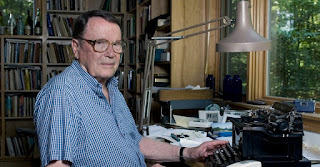
There is no good ending admits fade-out.          —Geoffrey Hill, "Improvisations for Jimi Hendrix"  Richard Wilbur: The image of his poems' cymbal-crash endings stayed with me. Richard Wilbur died over the weekend , shortly before my greatly anticipated 50th-anniversary class reunion at Kalamazoo College next weekend. The coincidence has significant force for me because of a striking image suggested to me by a classmate more than a half-century ago. When I first encountered Wilbur's work, I was a sophomore English major at K College. Something that she said about Wilbur's poetry — the best of which was fresh and modern in 1964 — has stayed with me. "I like the way his poems end with sort of a cymbal crash," she said. I don't remember which Wilbur poems she cited, but I'm sure we had some of the same ones in mind.  "Advice to a Prophet," for example, with its formal stanzas warning a generic prophet against an exclusively ...

Hooray for Hollywood: A well-deserved kick in the tailored pants of Harvey Weinstein, with a swipe at Hollywood's code of silence

Hooray for HOllywood! That screwy, ballsy, gooey Hollywood! Where when you venture behind the scene You see Harvey Weinstein (more than you care to): Whether starlet or barmaid, you may feel a star made And report it only if you dare to. Hooray for Hollywood! You'll be soaring if you make him feel good: Your talent's terrific (even if it's sub-par); Say yes, you'll go far; say no, he'll rant. It's just about sex, so suppress that gag reflex And keep your distance from that potted plant! Hooray for Hollywood! That phony, pure baloney Hollywood! Now you may come from Gotham or Australia, He'll try to nail ya before you say "Scram!" or "Ouch!" Don't doubt his moxie, it's orthodoxy: The way to stardom's still the casting couch. Hooray for Hollywood! Don't look for allies in the neighborhood: The culture there is all about protection For his erection, so try to make that monkey look good! Mum's been the word for years...