Choosing bang over whimper: Phoenix Theatre's 'Wasabia' explores end games
 |
| Vivian exults in partnering with Di and Val. |
Like any other sport, warming up for death may be a fitness regime, or it may look like death warmed over. The tension between approaches to the final chapter facing everyone may invite more than a touch of humor. Wendy Herlich went full bore into mortality's comic potential in writing "Wasabia," a 2024 one-act that the Phoenix Theatre is opening this weekend in the Basile Theater.
The booklet for the new production, directed by Brian Balcom on the Phoenix's Basile Stage, carries a playwright's note that indicates personal reasons for dealing with death unflinchingly, as well as humorously. She has centered the emotional glitch that brings humor into play in several episodes that involve two secondary characters in various guises, representing drugs used in assisted suicide.
Legal protection for the choice is under consideration or approved among an increasing number of states. That trend is the subject of one of the sketches, a vaudeville-style production number that's an amazing achievement to bring off in such a small space.
But the focus of "Wasabia" is on just one woman eager to make such a choice and trying to manipulate the hospice system in order to end her life. Jan Lucas plays Vivian, a proud intellectual sinking into her senior years with the symptoms of dementia approaching. Can anyone blame her for manipulating people?
She exercises that talent on Carla, a social worker in training to visit hospice residents. The idealistic teen, with family issues of her own in the shadows, comes to Vivian's apartment by mistake, then follows a memorized script of eager concern to be of help. That rubs Vivian the wrong way, of course, and there's a passage of dialogue that remotely echoes the tense "meet-cute" scenes of countless rom-coms.
How that shifts into a genuine friendship, still with Vivian's manipulativeness intact, is fascinating to watch in the performances of Lucas and, as Carla, Hannah Luciani. Carla becomes an ally in Vivian's counterpunching against a neighbor fond of noisy lovemaking; shoes thrown against the adjacent wall are the weapon. Vivian chooses the weaponized shoes as resolutely as Trump selects footwear for his cabinet.
The young visitor supplies the words occasionally missing from the old woman's voluble conversation. I found it odd, though, that when Vivian wants to mention a cartoon character with large ears, balling her hands to each side of her head, the teenager guesses Dumbo rather than Mickey Mouse. Is either Disney icon known to present-day teenagers? Anyway, it seems shrewd that Herlich has placed her main character in the early stage of Alzheimer's such that the audience's sympathy can be stirred without too many clinical signs of mental decay burdening the characterization.
When Jan Lucas plays an old woman, it's thrilling to see that the look of age is supplemented by signs of senior-citizen status in voice, facial expression, and gesture. It amounts to the wisdom we habitually attribute to long and often difficult experience. It's what makes Lucas' performance in the one-actor show "Apples in Winter" one of the most memorable Basile Theatre productions to me after more than seven years, and with what may be this blog's highest number of page views for a theater production.
Apart from the rapport between Lucas and Luciani as expressed via Vivian and Carla, the fitting caricatures played by Arika Casey and Jennifer Johansen are a marvel of pop-culture impersonations. They are partners as the crucial drugs Val (Valium) and Di (Digoxin), fatally guiding Vivian through droll sketches mocking game shows involving marriage and competitive success in suffering. All are emblematic of ways to process life struggles that also bring Carla's woes to the fore.
The playwright tangentially involves us in Vivian's decision as Val and Di circulate somewhat and interact with the audience. A crucial link to Vivian's accomplishing her goal is the character of the marginally employed Brody, played with a lingering sense of doom and a veneer of nonchalance by Andrew Martin. Brody is how Herlich helps us realize that the choice of exit is never free of moral seriousness or even the need for accomplices.
In the immortal terms T.S. Eliot chose to define the world's end, the end of each of us could be foreshadowed: The anticipatory whimper may be inevitable; the bang is likely out of our hands.
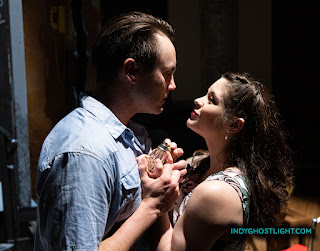
[Photo by Indy Ghost Light]


Comments
Post a Comment