World premiere plus a world-shaking oldie elevate ISO season's approach to finale
The bad luck superstitiously attached to Friday the 13th seems to have bypassed the Indianapolis Symphony Orchestra, thanks to a buoyant world-premiere concerto that brought downstage as soloists two of the ISO's most impressive principals: oboist Jennifer Christen and bassoonist Ivy Ringel.
 |
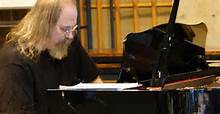
| Hanna Benn is comfortable across genres. |
The double concerto, with the accompaniment of strings plus sparingly used percussion, is an
ISO commission. Its three movements embrace a spectrum of lyricism for both solo instruments. In program notes plus a pre-performance onstage interview conducted by ISO music director Jun Märkl, Benn explicitly credited her orientation toward choral music, nurtured since childhood through the Indianapolis native's participation in Christ Church Cathedral choirs and developed since then.
 | ||
| Jennifer Christen and Ivy Ringel, double-concerto soloists |

Differentiation of the two instruments becomes more pronounced, but the adherence to a through line is sustained. What the composer describes as the "almost minimalist" cast of the finale has its repetitive gestures seconded by vibraphone. There's nothing doctrinaire about that stylistic borrowing. The conclusion is gently shared by soloists and orchestra without spectacle, in the straightforward manner of conventional minimalism.
The possibility that the new work might be taken up elsewhere seems strong, given the
enthusiastic reception "A Through Line" received Friday night from a Hilbert Circle Theatre audience boisterously populated by IDRS attendees. The work had an unmistakable sheen and ready emotional appeal in its first performance by Christen, Ringel and the ISO ensemble conducted by Märkl. It can be heard again today at 5:30, in a performance to be broadcast on Monument Circle.
A canny choice for program opener is Ravel's "Alborada del Gracioso," partly because of its lonely, plaintive and somewhat self-mocking bassoon solo in the middle. The main section is a lavish display of Spanish rhythms and multicolored percussion. Friday's performance came off with the predictable panache the ISO music director elicits in matters of rhythm and accent. Mark Ortwein, assistant principal, fills the contrasting court-jester role in these performances; his performance Friday merited the solo bow he got to a tumultuous ovation.
The character of the solo foreshadows the tortured individualism that dominates Berlioz's "Symphonie fantastique," a title rarely translated for Anglophone audiences: it seems like slangy hype to call it a "fantastic symphony." But of course it is, even starting with the title the composer attached to it with autobiographical implication: "Episode in the Life of an Artist." There had been nothing like it: Beethoven's then-recent Ninth Symphony, centerpiece of the ISO's program next week, sends a trailblazing message of universality; the Berlioz masterpiece is a projection of private, interior states on a daringly large scale.
Berlioz might be called a distant progenitor of the 27 Club. It was in 1830, about the time of the French composer's 27th birthday, that this amazing work first burst upon the world, Rather than the actual doom-seeking deaths at that age of rock stars such as Jim Morrison, Jimi Hendrix, ,Janis Joplin, and Amy Winehouse, Berlioz imagined his demise musically. He was to survive the introduction of his Fantastic Symphony by several decades, even though his infatuation for an Irish actress at the root of his fantasies resulted in an unhappy marriage to her, along with the resumption of his roving eye.
Of the many soul-stirring aspects of Friday's performance, I was especially struck by "The Ball," the work's second movement. One can often hear accounts of this music throughly inflected by the subject's monomania, but Märkl's interpretation allowed the collective zest of the waltz to dominate. To me, this is wiser than reminding us of the persistence of what Berlioz called the "idee fixe," the theme that establishes the through line (thanks, Hanna!) of "Symphonie fantastique." 
Jun Märkl:"The Ball" is in his court.
The poignancy of the work is centered in this unpretentious movement, as it indicates the artist's isolation from the reigning pleasures of social interaction. It is vivid, well-designed music to which conductor and orchestra lent a full measure of exuberance, only somewhat distantly shadowed by the despair and drug-haunted visions that metastacize in the fourth and fifth movements.
The first movement, especially the handling of forceful interjections and other indications of the subject's mental disturbance, amounted to an exemplary portrait of romantic passion on the verge of going overboard. The "Scene in the Country" (third movement) presented, as if in further support of the IDRS conference, the exquisite, distanced dialogue of oboe and English horn, far from the lighthearted society of "The Ball."
Finally, of course, there could be no holding back. The "March to the Scaffold" and "Dream of the Witches' Sabbath" carried out all the garish orchestral scene-painting in a manner worthy of Hieronymus Bosch, with the visual and sonic treat of two large bells struck ominously from the onstage gallery.
It was indeed the kind of dream you don't soon forget, certainly no "garden of earthly delights" to its composer. It amounts to a landmark case of Freudian sublimation, displaying a mastery of the demonic that it's been posterity's delight to experience for almost two hundred years.


Comments
Post a Comment