ISO extends balm, not bombs (rhetorical or otherwise) as new classical season opens
A first-rank soloist debut deserved major attention as the Indianapolis Symphony Orchestra opened the 2025-26 Classical Series Friday night under the direction of its apparently visionary music director, Jun Märkl.
Though the progress of current contract negotiations is always a major concern, artistically the ensemble is in fine fettle, with a bunch of new members, including several in principal positions. Though I listened to Saint-Saëns, Fauré, and Dvorak with my usual attentiveness, I glanced frequently at the personnel page to get me up-to-date about whom I was hearing. The orchestra was delivering at Hilbert Circle Theatre on the same high level as it had achieved when it finished 2024-25 in June.
 |
| Guest soloist wowed ISO audience in two works. |
The immensely appealing soloist this weekend was Daniel Müller-Schott, a German cellist. Like Märkl, he is a native of Munich. The rapport evident Friday in pieces for cello and orchestra by the two French composers went well beyond the shared birthplace. Fauré's "Elegie" was an ingratiating supplement to the main event, Saint-Saëns' Cello Concerto No. 1 in A minor.
"Elegie" rewarded the interpretive delicacy also at play intermittently in the concerto. Its subdued ending was like something held in awe to underline the memorial suggestions of the piece as a whole. The soloist's range of excellence was more lavishly displayed in the Saint-Saëns concerto.
His phrasing was invariably full and robust, even with a wide range of dynamic control. No softening of volume in the solo part gave any feeling of dying away, and he conveyed partnership with the orchestra consistently. His sidelong glances at the orchestra or the conductor, something evident in today's most eminent concert cellist, Yo-Yo Ma (so much that it's been parodied by Hauser), had a natural, collegial feeling and didn't seem a kind of nervous habit or merely a way of releasing tension.
He really wanted to know, and respond to, what his orchestral partners were contributing from moment to moment. The virtuosity required in the final section ("Allegro non troppo") found Müller-Schott always at the ready, the accuracy of rapid passagework never eluding his grasp, and the shared respect between podium and soloist always in force.
For an encore after the rapturously received "Elegie," the soloist tossed off, with ample attention to its origins in the gigue dance form, the final movement of Bach's Cello Suite no. 3 in E major. The cellist's Lincolnesque stature and expressive gratitude for the audience response had positioned an aura over the depth and flair of his playing. He will surely be welcomed warmly on any return visit to Indianapolis.
Saint-Saëns' "Baccchanale" opened the concert, with its rhythmic crispness sustained from the animating percussion outward through the ensemble. This stirring music from the opera "Samson and Delilah" is like a picture postcard from ancient culture, filtered through the composer's well-schooled Late Romanticism.
 |
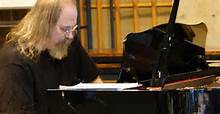
| Jun Märkl accentuates the positive. |
What everyone had most anticipated filled the program's second half. The Dvorak Symphony in E minor undoubtedly accounted for the large crowd aware they would hear what today's ISO might make of one of the repertoire's greatest hits.
"From the New World" is the inscription the Czech composer applied to his Symphony No. 9 in E minor, That entire prepositional phrase is important in emphasizing the composition's being a message to the Old World that a composition created as an outgrowth of time spent in America would be worth wide acquaintance across the pond. So it became, such as when decades ago Harold C. Schonberg, dean of American newspaper music critics, complained of the unimaginative programs European orchestra tended to bring to their tours here, his example was the Dvorak "New World": "This symphony is not exactly unknown in New York," he told a music critics' seminar with heavy irony.
In his popular study "The Lives of the Great Composers," Schonberg also made an extended comparison of Dvorak and other composers of his era about their mental well-being: "He remained throughout his entire creative span the happiest and least neurotic of the late romantics....With Handel and Haydn, he is the healthiest of all composers."
That is evident in the Ninth despite its minor mode and frequent dark passages, starting with the brooding cellos and basses in the first-movement introduction. However the tug of homesickness may have animated him, the Czech composer wanted to salute his inspirations from his American visit. The strain of folk music, never absent from Dvorak, is rich in how the composer formed his melodies. As played Friday, the flute tune in the first movement had momentary "hitches" when it was taken up by the violins, suggesting informal music-making.
The "Largo" has a melody so famous that it has been wrongly placed as derived from the spiritual "Goin' Home," when in fact the song was made from the tune in the symphony. Roger Roe played the English horn solo with predictable steadiness and passion, never sentimentalized (thanks to minimal vibrato, in contrast with what you can hear in European recordings). The conductor fashioned a lingering ardor from the orchestra, and I was struck by the rapt attention the audience paid throughout.
The dance rhythms in the scherzo were as lively and pointed as similar effervescence had been in the "Bachanale." The finale was full bore from the start, with exemplary balances and the requisite triumphant note that confirms the characteristic outlook that Schonberg cited. The recollection of earlier music up to the final measures was made as if everything recalled was not out of idle fondness, but from belief that such positive memories in the score are essential to appreciation of the work.
That suited the speech Märkl gave from the podium before the performance, urging the audience to take in the music as a positive force in their lives, something that might boost a level of happiness that is sometimes hard to find in the outer world of strife and multiple antagonisms. I couldn't help wondering if similar speeches were given bravely from German podiums in the last days of the Weimar Republic. We can only hope the outcome will be better here.


Comments
Post a Comment