Showing how enduringly timely it is, ''The Crucible" lends classic touch to Southbank Theatre's season
Long celebrated for its blend of history with contemporary issues, "The Crucible" is one of Arthur Miller's most enduring plays. It occupies a position of timeliness in Southbank Theatre Company's current schedule.
 |
| Betty Parris cries out from sickbed as influencer Abigail Williams looks on. |
Before each of two acts, artistic director Marcia Eppich-Harris's sound design folds in audio clips from the McCarthy era through President Trump's promise that there's lots more to come. The audience is put on notice that finding such parallels is by no means a stretch.
 |
| Tituba relives her mystery as Reverend Hale seeks heaven's aid. |
The first act rolls along impressively, with the large cast making the tension vivid, from the girls' ritualistic romp around a cauldron and a fire guided by Tituba, a slave from Barbados, through domestic and pastoral conflicts that are barely under control until the demons of witchcraft are raised. Tituba's mesmerizing dance with the girls, guided by an exotic religious perspective already likely to stir suspicions among narrow-minded Christians, was beautifully staged, wth symbolic gesturing and choreographic precision, accompanied by recorded percussion. The set and lighting had everything prepared for the mystery that spells disaster for Salem.
The intersection of private life and its public resonance becomes the play's main focus as the audience learns about the troubled marriage of John and Elizabeth Proctor, a farm couple with a questionable degree of loyalty to Salem's church and civic life.
 |
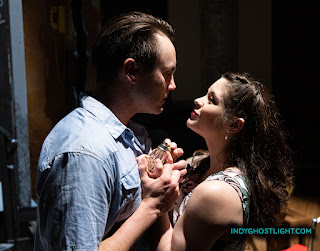
| John Proctor and Abigail Williams can't let go. |
Brian G. Hartz, in his last local theater performances before he moves with his family to Vermont, fills the fierce yet conscience-stricken role superbly. When you can sympathize with a good character in the face of his shortcomings, you know you're encountering a secure representation. Morgan Morton plays the farmer's wife; her performance rose from troubled victimhood to heroic stature as John becomes ensnared in the witch hunt and her ultimate loyalty emerges. There was genuine warmth and "chemistry" in the bond displayed right through the tragic ending.
The play's femme fatale is Abigail Williams, the girls' ringleader, nurturing a plan for retribution that uses religion as a shield. "Vengeance writes the laws" runs a line near the end of the first act, and Abigail is its Draco. Hannah Embree played the role with a well-regulated blend of sinister control and desperate sensuality, keeping her hooks in Proctor, her partner in adultery.
Other central roles were immediately given full dimension. Doug Powers is the minister Reverend Parris, who comes upon the girls' dance in the forest and who is at his wit's end both about his daughter's catatonic spell and controversy over his ministry. More secure in his position as a specialist in dealing with demons is John Hale, a cleric brought in from Beverly to ascertain the truthfulness of disturbing reports of premature death and bizarre illness. J. Charles Weimer played the part with a scholar's self-possession undergirded by a fervor that he turns out to understand less than he had thought.
That transformation becomes so intense in the second act that the performance almost got unraveled. The same could be said about the way Powers' portrayal became noisy and blurred. It's clear that both characters practically descend into madness as the community hysteria takes hold, but it struck me that the borderline overacting may have been triggered by an unfortunate circumstance: because of a cast change, director Bryant had to assume the overarching authority of Judge Danforth, the state official charged with determining who gets executed and who may survive. His probe is verbose and exacting, and thus challenges the audience as well.
The substitute's keyed-up acting seemed trying to compensate for his having to have script in hand, though he handled it competently. The detailed denouement of the action lacked variation in tone, as a result; the emotional tug of the Proctors' fate couldn't quite relieve a certain tedium in the dramatic dotting of i's and the crossing of t's.
It's expected that Bryant will be off-book before the run ends Nov. 2, Eppich-Harris told me. It's reasonable to suppose that the sensitivity among all players to their tasks in the first act may extend to the second act just as movingly as the production continues. In any case, "The Crucible"'s pertinence to our own time will be confirmed.
[Photos:; Indy Ghost Light]


Comments
Post a Comment