Meeting the world with rapture: 'They Call Me Genêt' reintroduces Janet Flanner to her hometown
As with many who exile themselves with distinction from a provincial upbringing, the curiosity that fed Janet Flanner's writing career was nurtured in the world she left behind. Before she was dubbed "Genêt" by New Yorker magazine founder-editor Harold Ross, she carried the prestige of a well-established Indianapolis family, a talented daughter who got a brief start in journalism here as movie critic for the News. She came out as a lesbian after a likewise brief marriage, then settled in the French capital, where her "Letter from Paris" was a regular feature in the well-written and -edited, and eventually well-heeled, magazine.
"They Call Me Genêt," D. Paul Thomas' lively, variegated interpretation of the New Yorker's European correspondent for a half-century, takes Janet Flanner off the glossy page as so much more than a prestigious byline. As an extended "au revoir" to Paris set in 1975, it brings the thorough, exacting reporter and perpetually keen observer back home to her roots as a "Hoosier optimist," as Ross called her. In this play, she is embodied in a riveting, multifaceted portrayal by Jen Johansen.
Flanner had been formed as a writer through such fondly recalled lessons as the architecturally pristine sentence-diagramming she learned from a revered English teacher at Tudor Hall School for Girls. Decades later, as she composes her final "Letter from Paris" in the midst of packing for her homeland return, she wrestles with finding the right word for each context, as was her normal practice. She imagines both Ross and his successor, William Shawn, being pleased with the choice of "paucity" over "scarcity" in a phrase describing how unexpectedly few are the fruits this year (1975) in the Seine Valley, where she is on vacation but unavoidably writing as she pays attention to her world.
 |
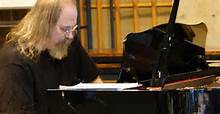
| Janet Flanner works on her final Letter from Paris. |
"Janet Flanner's World" is the apt title for a 1979 volume subtitled "Uncollected Writings 1932-1975," a copy of which is the only book of hers I own. The long piece I keep returning to is "Führer," a lengthy portrait of Adolf Hitler from March 1936. It's astonishing how steady and painstaking a sketch of the German dictator she fashioned here. It manages to make clear the monster Hitler was, though the Final Solution and the maniacal military actions of the Second World War were years away.
I have reread this piece with alarm and delight (two emotions that rarely go together) because there's neither sympathy nor condemnation explicit in her language, simply great reportage. Whatever she turned her attention to seemed to have brought forth an empathy (where appropriate) that never compromised her professionalism. To find equally persuasive depictions of Thomas Mann and Bette Davis side by side in this book is among its many marvels.
Thomas's play has focused on Flanner's characteristic wide range. As Shawn wrote out of his deep personal acquaintance in an introduction to "Janet Flanner's World": "A stranger to fatigue, boredom, and cynicism, she met the world with rapture and wrote about it with pleasure." In presenting a rounded picture of the woman who earned that praise, Thomas doesn't skirt his subject's moods of complaint and sadness, her love laments or the pain of her father's suicide. Those qualities and experiences illuminate Johansen's performance, which I saw Friday night at the District Theatre, where the production continues through July 26.
Costumed elegantly but not showily (Guy Clark's design), Johansen adroitly changes focus as her Janet entertains distractions to which she naturally lends eloquence while simultaneously packing up and completing her last "Letter from Paris." The whole production is sensitively designed in all respects, and directed with insight by Chris Saunders.
Thomas has loaded the script with Janet's observations, some of them self-deprecating (a depiction of her face resembling an old pope and a whale, for example), and opinions asserting a belief in democracy and individual freedom that resonate today.
There is an abundance of name-dropping, which quite suits her actual range of acquaintance among famous people as well as the ordinary sort. Typically, she deplores her occasional bashfulness and missed opportunities to approach celebrities to both professional and personal advantage.
Ernest Hemingway was one titan with whom she had a steady friendship lasting decades, dating from her pre-Genêt days, according to Hemingway biographer James R. Mellow. In the play, she admires the author's ability to get whatever he saw directly onto the page, at his best bypassing the fussy quality-control department of the word factory most writers struggle with.
One deft feature of the script is how a lengthy description of Pablo Picasso seen across a room in 1920s Paris delays mentioning him by name. This foreshadows a climactic speech in which an eventual conversation with the great artist comes to mind and bursts forth as her personal credo.
The last paragraph of Genêt's Picasso obituary tribute (April 1973) has the right placement of every word: "Picasso will rank as the most prodigious artist of our time. He was a man fortunately composed in terms of excess. Even as a genius, he had more gifts than he needed."
Janet Flanner would have scorned placement among the world's geniuses. Yet in "They Call Me Genêt," we get to know a fortunately composed woman, self-disciplined to avoid excess, who used her gifts according to her needs, thus acquiring a special niche in the journalistic pantheon. Johansen's impersonation of her in "They Call Me Genêt" directs our merited attention to that place of honor, confirming that Genêt's career-long harvest bore no paucity of fruit.


Comments
Post a Comment