Centenary observance of an innovator: Rob Dixon leads Coltrane tribute
 |
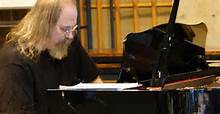
| Rob Dixon holds forth in Coltrane celebration. |
In corporate terms, the quartet that offered two Coltrane sets Wednesday at the Jazz Kitchen did business as the Indianapolis Jazz Collective. The band took in as special guest Lasana D. Kazembe, a spoken-word artist who proved apt for evoking the Coltrane idealism and displaying an original, intense manner of representing Coltrane's musical breadth through verbal spectacle.
Kembe's contribution to "Naima," Coltrane's tribute to his first wife, was rich in imagery going well beyond the tune's dedicatee. The melody lends itself to such extrapolation, and the instrumental-vocal balance was exquisite in the first set's performance.
After "Giant Steps," the set-opener that immediately laid out the unique character of Coltrane's personality as a composer, Dixon welcomed Kembe to the stage for "Lonnie's Lament." The poet launched his part of the celebration with a Coltrane quotation: "I want to be a force for good." The format fruitfully alternated Kembe's words with Dixon's solos. T'he dialogue blossomed as the ensemble smoothly incorporated two admirable drummers, Kenny Phelps and Richard "Sleepy" Floyd. The rest of the rhythm section consisted of bassist Nick Tucker and pianist Steve Allee.
After a version of "Giant Steps" that thankfully avoided "sheets of sound" cliches, Dixon's determination to put an individual stamp on the tribute took off with an early Coltrane masterpiece, "Moment's Notice," in which the percussionists established a rock beat and Allee laid down a vivid personal statement at the keyboard. He would later turn to the electric piano to accompany "Angelica," a ballad lifted from Coltrane's recorded collaboration with Duke Ellington, moving back to the acoustic instrument for his solo.
Dixon's adaptability, allowing him to honor Coltrane while impressing his own style on the material, surged in Coltrane's 'Impressions." He had the modal language well in hand, in which a scale provides the basis for both theme and improvisation instead of conventional chord changes. His solo was followed in suit by Allee exhibiting a similar expressive range, evoking aspects of his formative mentor, the sainted Claude Sifferlen. The band shrewdly reduced the percussion section to Phelps for this number.
Floyd returned to the bandstand for the concluding piece, a work by Coltrane's second wife, Alice, whose loyalty and musical fecundity brought into play the meditative aspect of Coltrane's late style. Considerable Kazembe effusions provided a hypnotic effect. Dixon varied the ensemble color by turning to alto saxophone.
The artistically immortal saxophonist died in 1967, his 40 years of life shortened by cancer at a point where his further development was unpredictable. Alice Coltrane's effect on his music was sometimes received as an unfortunate change of direction. Another way of interpreting that is that his penchant for exploration was active up to the end.
[Photo by Rob Ambrose]


Comments
Post a Comment