ALT brings all dimensions of the family bond to big-city life in 'The Humans'
There's a bunch of classic American plays that probe family life, usually scrutinizing love that's genuine but contains toxic elements. Those charge the drama, enlisting the audience's emotional engagement. Among them are "Long Day's Journey into Night," "The Glass Menagerie," "Death of a Salesman" and "All My Sons."
 |
| The set of "The Humans," a present-day Chinatown apartment |
"The Humans," with a week more to run in an American Lives Theatre production at Phoenix Theatre, stands out for me because it goes a step further: The bond of love is genuine, and non-toxic, but is poignantly shown not to have a great chance of winning out.
Written in a style that mirrors intimate conversations among people with a long mutual history, playwright Stephen Karam shows how crippling accidents of sickness and circumstance wound people and threaten genuine reciprocal regard.
With an endlessly able cast, director Matthew Reeder has to keep plates spinning in the air like an acrobatic Chinese juggler. The style is hyperrealistic, with speeches overlapping, frequent interruptions, and conversational changes of direction. There are no set-pieces, few pregnant pauses in dialogue. It's not the sort of play an actor might select an audition speech from.
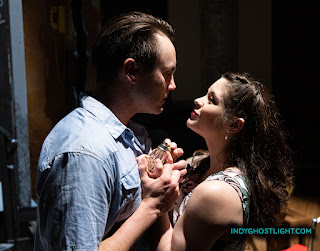
We see the Blakes gathered to celebrate Thanksgiving in a lower Manhattan duplex apartment into which one of the daughters has just moved with her boyfriend. Brigid (Susannah Quinn) is a composer anxious about her foothold in a career dependent upon academic success; her sister Aimee (Jenni White) is a lawyer dealing with bad medical, romantic, and professional news all at once.
Both young women are pursuing their dreams in Manhattan, already a decision causing problems for their parents Erik and Deirdre, attempting to live the American Dream in the family's hometown of Scranton and sticking to their Catholic faith in the face of their daughters' drifting away. Their dream of a retirement lake home is cloudy with difficulties, including a hidden one in Erik's work life.
 |
| The Blake sisters have a heart-to-heart. |
Brigid's boyfriend Richard (Trent K. Hawthorne-Richards), an idealist pursuing a degree in social work, sends off-putting information that he will soon be eligible for a trust-fund legacy. Erik (Eric Bryant) jousts with Richard, implying that only lifelong efforts like Erik's deserve life's rewards. Only later do we learn why he is so triggered by the prospect of having a son-in-law who's well off.
Wife Deirdre (Eva Patton), who's devoted to her volunteer work and quirky intellectual pursuits, senses there are barriers to getting respect, despite her careful attention to her mother-in-law, called Momo (Wendy Brown), who's deep into senile dementia.
It's the kind of family where every gesture of devotion and respect may generate some kind of backlash. Family teasing, unless it takes a rough turn, rolls harmlessly back and forth, and family traditions encompass games and songs.
What could go wrong? The unstable setting provides some clues, touching gingerly on the family's physical and experiential closeness to the effects of 9/11. The apartment is roomy but burdened by technical glitches, including uncertain electricity, and an inconvenient split of facilities between two floors. The annoyance factor of Manhattan living is the play's poltergeist; sources of joy must be clung to before they flee. Brigid's pleasure in her flat's one large window is compromised by the view of an interior courtyard littered with cigarette butts.
A spiral staircase is center stage. There's a noisy neighbor, plus unsettling noises from trash
 |
| Paterfamilias Erik gropes his way through life. |
compactors, toilets, and the like. An elevator outside the living quarters is necessary for this family reunion to get wheelchair-using Momo from one level to the other. The family is challenged enough to coax her into occasional bursts of intelligence and to forestall dreaded temper tantrums. The mention of these loads the drama with a counterpart to the famous Chekhov's gun. To avoid spoilers, I'll just say it's well-placed in "The Humans," not long before the holiday gathering breaks up and Erik is isolated by a plunge into more than one kind of darkness.
Set and sound design, by Rozy Isquith and Kairon Bullock, is outstanding in precision and impact. Tatyanna Rodriguez's lighting design is a crucial element that acquires the stature of a nemesis character. In this soul-stirring production with outstanding performances, "The Humans" is a masterly reminder that, however much love is essential for social cohesion at its most intimate, it can never be strong enough to keep every threat at bay.
[Photos: Indy Ghost Light]


Comments
Post a Comment