'Oak' at Phoenix casts anxious gaze on wider world from familiar, haunted one
The way the Phoenix Theatre production of Terry Guest's "Oak" enfolds the play in all respects makes a strong case for a piece of theater that manipulates its audience comprehensively.
 |
| Pickle shouts her frustration to Big Man, her brother. |
Set in the deep south, far in spirit and somewhat geographically from the modern urban sprawl of Atlanta, which beckons like a distant gateway to mecca, "Oak" focuses on a malign spirit pervading the tree of the title and its nearby creek.
Phoenix Theatre's black-box stage (Basile Theatre) is the multi-media setting of the production, which runs through June 8. Attendees walk into a darkened space with swampy growths dangling from above and bursts of sepulchral filtered lights; mysterious sounds pierce the gloom. This environment envelops everyone for the ninety-minute uninterrupted run of the performance. Questions of identifying and interpreting the environment and what happens there are as pervasive as mist and fog, and belong to characters and attendees alike.
Returning from their well-received teamwork in the 2022 Phoenix production of Guest's "Magnolia Ballet" are director Mikael Burke, lighting designer Laura E. Glover, costume designer Anthony James Sirk and composer/sound designer Brian Grimm. The unanimity of these production elements is clear in the new show, which is part of the National New Play Network's Rolling World Premiere, a Phoenix affiliation of long standing. Robert Koharchik applies his seasoned set-design knowhow to the production, and a crucial part of the magic is the puppet design and props artisanship of Kristin Renee Boyd.
 |
| Peaches lays down the law to her daughter. |
Pickle (Jada Rowan) is a restless teen eager to escape a small African-American community whose cultural legacy doesn't go much beyond the legend of a woman who escaped slavery long ago but is mentally trapped in guilt about her abandoned baby. Did she become a monster living in a treacherous waterway known after her as Odella's Creek, the site of mysterious child disappearances up to the present day? Or is the story a convenient, if unfathomable, explanation of unfortunate deaths and an indispensable part of local folklore?
The difficulty of keeping oppressed families intact under the calloused thumb of Jim Crow is the larger picture of what Pickle and her little brother, ironically dubbed Big Man (Joshua Short), face under the cautious control of their mother, Peaches (Psywrn Simone). An abandoned wife of commanding authority as a mother, Peaches keeps household body and soul together through maintenance drudgery at a corporate store while hanging on to faded dreams of glamour far away. In the neighborhood, but less secure in family ties, is a sprightly cousin named Suga (Tracy Nakigozi). Her bond with Pickle is sweetly represented by a ritual gesture of greeting and farewell, a private hand-jive choreographic pattern.
 |
| Keeping her watch: First Lady Temple |
Thoroughly convinced by the performances as I was, as well as the airtight atmosphere of the production's setting, I came back to the forced artificiality of the writing. The script is not known to me, but I kept hearing evidence of a playwright determined to have us admire how thoroughly he has put his stamp on his characters. Clearly self-infatuation can work for a clever author, and thus give a skillful cast lots of solid material to project to audiences. By no means did I feel director Burke has allowed or nudged his actors to overact; he and they are brilliantly committed to what they have been given, and it shows — properly.
"Oak" is worth seeing for the production's sturdy embrace of its material, but I'm reminded somewhat remotely of the way another playwright was overbearingly proud of his characters and seemed to say: I believe so intensely in these people that every word of dialogue and stage direction I've set down is something you can't avoid feeling as strongly as I did at my desk.
That playwright's vogue is largely over, he had his time in the sun, and his name is Eugene O'Neill. Terry Guest may well deserve the same degree of attention, which would not make for a bad career, would it?
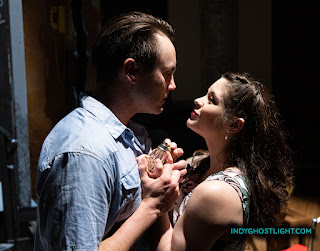
[Photos by Indy Ghost Light]


Comments
Post a Comment