Another local collaboration of concert presenters brings Sean Chen and Escher String Quartet to town
Not just a good idea, but a flawlessly executed one: the first-time collaboration between Ensemble Music Society and American Piano Awards, who presented pianist Sean Chen and the Escher String Quartet at Indiana Landmarks Center Wednesday evening.
The program of French music from three centuries had every part in place, building to heights in the second half with the Piano Quintet in F minor by the Belgian native Cesar Franck, who lived most of his life in Paris and exerted deep influence on his era's music.
 |
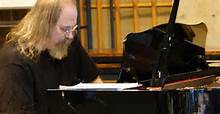
| Sean Chen won at APA 2013. |
The supremely variegated yet uncannily unified performance the five guest musicians offered Wednesday got me reflecting on the string ensemble's having named itself after M.C. Escher, a graphic artist famous for fantasies full of visual paradoxes, some of them architectural. That's probably less germane for me to the 1879 piano quintet than the work of an artist two centuries prior to Escher: Giovanni Piranesi, an engraver who also created elaborate imaginary structures in two dimensions. Rather than fooling the eye as Escher did, with a range of visual puns far wider, Piranesi deliberately overloaded the viewer with plausible buildings that seem perplexing mainly in their elaborate level of detail and juxtaposition of large and small elements.
 |
| Piranesi's richness of detail can be seen in Franck's musical terms. |
Instead, the performance was attentive to Franck's insistence on regulating his impassioned inspiration. That self-control, by the way, may have had its basis in his love for a young student, which Melvin Berger's "Guide to Chamber Music" makes central to his essay on the work. Mme. Franck found the work ugly, and might have suspected that her husband's extra-marital infatuation had saturated the music, Berger speculates. Be that as it may, the work is rich in emotional turmoil, but designed to make full use of carefully chosen material.
Chen and the Escher quartet had already displayed finely judged management of Franck's compositional energy in the first movement, where a torrential climax quickly but smoothly subsides into a hushed ending that they played as if it were the most logical way to deal with such an outburst. The second movement had a lingering, sentimental quality, with the strings drifting up, the piano drifting down, inevitably reinforcing a link with the composer's private ardor.
The concert's first half ended with Maurice Ravel's String Quartet, the first movement moderately paced, the second movement brisk on the whole, but well contrasted with its dreamy, intense second section.The Eschers seemed resolved to dispel the shopworn notion of Ravel as a cool customer, with the perfect craftsmanship of a Swiss watchmaker (to bring in Stravinsky again!). Such a characterization seems to cast into the shade the surging and dying emotional terrain this work travels. The individual melodic flourishes were well represented in the third movement, and the impression of holding back at times in the finale seemed appropriate to the enigmatic impressionist's emotional reserve.
Ravel's whimsical gift got an explicit outing in an arrangement for solo piano of "Five O'clock Fox Trot" from the opera "L'Enfant et les Sortileges." Chen, who won top honors in the 2013 APA competition, brightened the attractive colors of this enchanting excerpt, with its outdated "pop" and cross-cultural borrowings.
Chen opened the concert's solo portion reaching back fruitfully to the France of the ancien regime, Jean-Philippe Rameau with "Gavotte et six doubles" performed convincingly on a keyboard unmeant for a typical example of the baroque harpsichord style. The rhythmic profile varied agreeably, with the crisp articulation and rhythmic zest characteristic of the French clavecinistes. The incisiveness of Rameau was colorfully contrasted with Debussy in a relaxed vein with the slow waltz "La plus que lente." Both interpretations sounded true to their respective idioms.
The pianist's affection for one of the most difficult of "light" pieces, "The Sorcerer's Apprentice" by Paul Dukas, resulted in his arrangement of the orchestra original. It brought the concert rousingly up to the appearance of his concert partners, after stirring memories of the "Fantasia" scenario with Mickey Mouse as the presumptuous title character.
Chen didn't stint when it came to the work's complexity; this wasn't a matter of a musical walk in the park. The entanglement of the naughty sorcerer in magical powers beyond his control is fully reflected in the music, and Chen was up to the simultaneous, finger-bending demands of the score. There was evident joy in how he brought them off, as if virtuosity were child's play. Maybe that's how virtuosity should always strike the listener. A famous pianist once said that if he heard an audience member's compliment that something he played must have been a lot of work, "I know I've played badly."


Comments
Post a Comment