Family bond under duress: Indianapolis Opera offers polish, intensity in 'Rigoletto'
 |
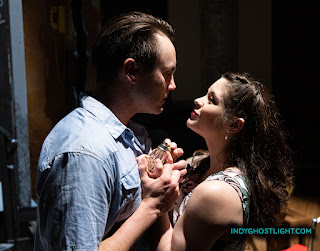
| Indianapolis Opera: Rigoletto entertains the Duke |
As Giuseppe Verdi started to evolve from the operatic structures he inherited from bel canto, he individualized the musical signatures of his characters, removed some of the cliches of presentation, such as big final ensembles, and musically deep-mined the verbal and dramatic material at hand.
The middle-period landmark of "Rigoletto," which is being produced this weekend by Indianapolis Opera at Tarkington Theater in Carmel, is a striking example of what the Italian master had embraced as his mission took shape. A perpetual hit with audiences since its premiere in 1851, "Rigoletto" lends musical rigor to the melodrama written by Victor Hugo.
The composer loved the story, and it's not surprising that there seems to be nothing offhand about how he treated Francesco Maria Piave's forthright yet romantically brilliant libretto. I'm probably not the only one who, after seeing a performance like the one presented Friday night, has the pleasant earworm repeating not "Caro nome" or "La donna e mobile," but even the distracted "La-ra, la-ra" music the title character sings in forced humor after he's lost his daughter through the trickery of courtiers that he's spent his work life mocking.
There's melodic inspiration in both those extremes and wealth in between throughout the opera, most of it expertly rendered on opening night. Alfred Savia conducted an intense, directly communicative performance, making the most of the score for reduced orchestra he is using. When the Duke of Mantua's court fills the stage in the opening scene, they are so active under Mark Freiman's directorial hand that it didn't matter much that the instrumental accompaniment isn't lavish; it helped set the scene, keyed to the chorus prepared by Cara Chowning.
The title role got a full-throated impersonation from the start by baritone Mark Rucker, made up in court jester costume somewhat restrained in comparison with readily available pictures of past Rigolettos, yet crucially waving a mask on a stick, and with a subtler shoulder hump that was just enough to represent the character's deformity. The director's rejection of "high-concept" direction that might have shifted the scene to "Cosa nostra" New York City is to be applauded. Everyone looked appropriately outfitted.
In that opening scene, there's a back and forth of masculine dirty dealings essential to represent the mutual loathing between the court and the jester. Men behaving badly — such a theme for our times, don't you think? The manipulativeness of two of the leading courtiers, Borsa (Will Upham) and Marullo (Ryan Henry), was strongly sung and acted. That's essential to the plot that quickly ensnares Rigoletto in an inescapable trap leading to his tragedy. It strikes the viewer (and listener) as so authentic that it becomes easy to forgive the unlikely twists and turns in the action.
As the corrupt Duke, Ganson Salmon used his well-honed tenor well, though the voice is light and somewhat monochromatic. He portrayed the Duke as used to getting his own way and pursuing his own pleasures, but somehow the large full-length portrait of him in the stage setting seemed more authoritative. He settled into the character in fuller dimensions in the third act, which helped confirm the strong contrast between the clown's fragile professionalism and the ruler's true power.
There were some stunning performances in supporting roles. Peter Volpe's sepulchral bass was a pleasure immediately in the cutthroat Sparafucile's introduction to Rigoletto in the first act's second scene. The way Volpe managed the exit line, holding onto the character's name way down low, was spine-tingling.
And it was nice to hear the tonal contrast between Volpe and Rucker; I have a couple of all-star recordings where it's hard to tell Rigoletto from Sparafucile unless you closely follow the libretto.
As the hired killer's seductive sister Maddalena, mezzo-soprano Laura Zahn was as stalwart and self-possessed an auxiliary villain as possible. Her strength in the thrilling third-act quartet was an invaluable asset among the voices of Rucker, Volpe, and Brandie Inez Sutton. The soprano was endearing as the hapless daughter Gilda, creating a character of real stature despite her victim status. Her second-act dialogue with Rigoletto displayed believable father-daughter rapport, and Friday night her performance enjoyed sterling support from the solo oboe of Pam Ajango.
"Caro nome," the indelible love aria, built upon characterization already rich in Gilda's deep infatuation with the Duke, presenting himself in disguise as a poor student. It's a first love with a vengeance, and Sutton's singing was in full connection to her acting. In "Caro nome," her trills were exemplary; there were a few instances in other places where her high notes had too much glare, but otherwise she delivered a well-controlled, aptly heartrending portrayal.
Finally, it needs to be mentioned that unless the fervor of Count Monterone is there, the very curse upon which all the action and Rigoletto's self-awareness hangs would be missing. Daniel Narducci supplied that almost spiritual dimension, rooted in the moral authority of a wronged man. Rigoletto's final line, though it was questionably supplemented by Rucker's nonoperatic roar, confirms the power centuries ago of a justified curse, with heaven's sanction forcefully implied: "La maledizione!"
[Photo by Roger Manning]


Comments
Post a Comment