Reinforcement of cultural diversity: joint recital by two prize-winners
 |
| Sirena Huang and Drew Petersen play Gabriela Lena Frank. |
Drew Petersen and Sirena Huang made sure the rare opportunity for a musical reunion would be readily appreciated by a near-capacity audience Thursday evening at Indiana Landmarks Center.
The pianist and the violinist, well-acquainted since they were students at the Juilliard School, opened their joint recital with a work they had studied at the New York City institution together: Beethoven's Violin Sonata no. 5 in F, op. 24 ("Spring").
The arrangement by which they could perform as a duo as young professionals was engineered by the International Violin Competition of Indianapolis and the American Piano Awards. Each organization holds their achievement at the highest level as competition winners in 2017 (Petersen) and 2022 (Huang).
Apart from the Beethoven work and their encore (Sarasate's "Zapateado"), the national significance of 2026 strongly suggested their program have an American cast. And so it did, with an explicit nod to the cultural diversity that has unfortunately fallen subject to political challenge over the past two years. Despite the sometimes conflicted notion of what the country's 250th anniversary means, the multicultural nature of its music stands tall in most responsible estimations.
The attractive "Spring" sonata was thus a way of self-introduction as an American duo, trained here in the European tradition, yet receptive to diverse influences from this country's musical heritage. Their partnership in a masterpiece from the standard repertoire was flawless, particularly in the delicately wrought three-against-four passages in the first movement's final measures. From that point, the tender slow movement emerged with the ease of a compatible dialogue, followed by the nimble, compact scherzo and crowned by a finale of unforced gaiety and charm.

A different sort of duo excellence made for a bracing juxtaposition to complete the first half. Gabriela Lena Frank, a composer now living in California who had an Indianapolis Symphony Orchestra residency here about 15 years ago, draws inspiration from her mother's Peruvian heritage. She admits to "always trying to figure out how Latina I am and how gringa I am."
The work Petersen and Huang performed here was "Sueños de Chambi: Snapshots for an Andean Album." Projections on a screen behind the musicians showed the photographs by Martin Chambi that inspired the composer, who admires Chambi's devotion to depicting ordinary life in mountainous Peru. Frank's musical language encompasses dance rhythms, atmospheric tone-painting, imitations in the violin of native flutes, and textural gradations to parallel Chambi's deep range of shades in black-and-white photography. The work was especially effective with the images visible one at a time as each linked movement was played.
The duo was reunited at the end of the program for two characteristic Scott Joplin compositions as arranged for violin and piano by Itzhak Perlman. The lyrical "Bethena," quietly ingratiating and affectionate, was followed by "Elite Syncopations," one of Joplin's livelier rags, with its succession of "strains" compatibly joined and zestfully displayed.
Each musician got an unaccompanied turn as well. For Petersen, it was a demanding powerhouse out of the minimalist genre. Early John Adams, before he varied the strictness of this music of "repetitive structures" (in Philip Glass' phrase) and became the most performed living American composer, wrote "Phrygian Gates."
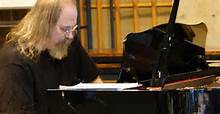
It's an ingenious, coordinated piece resting upon two ancient modes, with the Phrygian (E to E on a piano's white keys) prevailing. The transitions between figures built on the modes are sometimes smooth and barely detectable, sometimes abrupt and even jarring. The performer is constantly busy and does not have the satisfactions of "development" to lend dramatic or emotional nuance or narrative to the music. Yet the emotional impact is somehow present. The work is evidently a nightmare for page turners: Petersen's was game enough, but understandably you'd almost have to have had hours of practice as the performer never to get lost in the mass of notes. The pianist gracefully made good the page turner's slight errors.
Huang's showpiece was a commissioned work, "Sirens and Cathedral," by a friend of the violinist's. IVCI supported its production along with the gold medalist. The three sirens may be taken either as the ones who tempted the Homeric hero Odysseus or as the modern mechanical warnings of peril lying ahead. The final movement offers the relief of meditation and the settlement of the agitated, questioning signaling aroused in the first three movements. At first hearing, the work seemed like a neat embodiment of the emotional landscape outlined by the composer in a progression that made every bit of sense. It also showed off the expressive range of the IVCI gold medalist and her commitment to music off the beaten path.
[Concert photo by Mark Sheldon]


Comments
Post a Comment