Illuminating the mainstream: ISO navigates Rachmaninoff and Dvorak securely
To sort out my positive response to the Indianapolis Symphony Orchestra's April 24 concert, let me bring to the forefront two aspects of Jun Märkl's leadership that deserve more consideration: his uncanny insight into accompaniment and his rapport with the audience.
The music director has the orchestra in ready-responsive shape, to start with. If there's something subordinate to a soloist worth bringing out, he knows how to do it. When the violas dig into their prominent line in the first movement of Rachmaninoff's Piano Concerto No. 2 in C minor and the tempo increases, everyone is instantly on board. I had wondered at first if the "Allegro moderato" tempo was too moderate to start with, but very soon it was evident the launch was just right.
Near the end of that movement, there are some tender cello phrases that the ISO section produced with unanimity. In the second movement, with its prominent clarinet, nothing seemed incidental. When first-chair players are in the spotlight, this conductor elicits the most collegial support possible. The first violins produced remarkably soft music in supporting soloist Drew Petersen. The frisky episode in that movement cohered as if a single instrument were rendering it.
There was some effective underlining of the counterpoint (a rare feature in Rachmaninoff) once the main theme in the finale had returned, in between the first and second statements of the beautiful melody known in Great American Songbook terms as "Full Moon and Empty Arms."
I could go on and on, but these are a few highlights to show that in matters of tempo and balance (both technically and emotionally) the ISO is at a high point in its recent history under Märkl. Of course the featured soloist made the most of his prominence in this beloved concerto.
 |
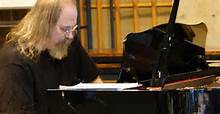
| Drew Petersen offered clearly defined sparkle. |
Well-known here as the 2017 winner of the American Piano Awards Classical Fellowship, Petersen can be flashy when the music calls for it, but also invites the gentle muse without hiding his light under a bushel: his left hand moved with authority in the "Adagio sostenuto" movement, not lured by the temptation to keep it in the shadows.
He displayed a fine sense of the work's drama, knowing where to hold the momentum in suspense. It was no wonder when he fully embodied the "Allegro ben ritmato e deciso" direction in playing his second encore, Gershwin's Third Prelude. He is a paragon of "well rhythmed and decisive" performance, and the concerto offered ample display of this clutch of skills.
After intermission, Märkl took microphone in hand to celebrate Dvorak and offer an informative and informal guide to the Bohemian composer's Symphony No. 8 in G major. He alluded to the composer's humble beginnings and how he got his performing feet wet as an opera-house violist.
Turning toward the ISO violas, the music director teased them about their privileged position on the concert stage, in contrast to crowded seating in the opera-house pit, with the assertive trumpets near at hand. He touted their prominence in the Dvorak Eighth, cluing the audience in to their role heading the lower strings and helping to represent that ebullient work's recurrent turns toward the dark side. He noted that principal violist Yu Jin was celebrating her birthday. Everything he said worked well: it was friendly and helpful, and carried the bully-pulpit charm of Raymond Leppard without that esteemed English predecessor's matey diffuseness. Märkl clearly loves audiences.
The performance was a marvel of contrasts and resemblances. The Adagio was set out with its question-and-answer, or call-and-response, rhetoric nicely highlighted. The vital shifts in dynamic level were intense and well-defined. The Allegretto grazioso was buoyant. The variations that make up the finale display Dvorak's structural adeptness and, as Markl drolly noted, allowed the violas to make their peace with the dominating trumpets (but where is the bombast, one may ask the annotator? See my mini-rant below). As played Friday each variation was like a gift bouquet with its own particular flowers lovingly arranged.
The concert opened with Bizet's Suite no. 2 from "L'Arlesienne." The first-movement Minuet was properly heavy and light by turns, with the orchestra fully engaged in each mood. In the familiar Farandole that follows, the orchestra shone throughout the catchy fast dance.
That prompts me to bring up a case of mistaken program-note guidance that I see often from classical commentators. "Bombast" and "bombastic" are misused if the words are taken to indicate something explosive, like a bomb. It's an understandable mistake, but in fact "bombast" simply means stuffing, cotton padding. If that's too etymological for some, even the figurative meaning (my dictionary says "pretentious inflated speech or writing") does not apply here. Some musical bombast is noisy, to be sure, but it would be great to restrict the word's application to unneeded, likely pompous, musical upholstery. Let me assert there is no bombast in the Farandole, which was excitingly rendered Friday night.
To close the concert at the other end, the orchestra offered a famous example of Dvorak's musical calling card, which made his reputation in central Europe but had the effect of stereotyping him as an ethnic composer. The inclusion of Slavonic Dance, op. 46, No. 8 in this program is allowing ISO patrons to absorb that authentic Czech quality as the neighbor of a major symphony that can be fully appreciated in abstract terms. To the cognoscenti in Vienna and Paris, Dvorak may have seemed provincial to some, but in the fullness of time and with such performances as Friday night's, it's clear he was no country bumpkin.


Comments
Post a Comment