A safe distance: ICO celebrates 'Shakespeare and Love,' not 'Shakespeare in Love'
 |
| Adam Golka, Matthew Kraemer and ICO revel in top-flight Mozart. |
Whatever Shakespeare's characters put their minds and their voices to, they likely had something lasting to say upon any subject. The fact that we don't know what William Shakespeare felt or said personally about anything, from the spotty biographical evidence available to us, didn't prevent such questionable delight as "Shakespeare in Love" generated a generation ago — a costume rom-com allowing us to wallow in the young Bard's world as a theater careerist hungry for patronage, creative encouragement, and, on the side, romantic success.
For the sake of a believable themed program to open its season, the Indianapolis Chamber Orchestra came up with a more prudent paraphrase of that 1999 movie's title. So Matthew Kraemer and his ensemble began the season delivering "Shakespeare and Love."
That allowed for a little separation, which invited Adam Golka's solo appearance in a Mozart piano concerto (No. 20 in D minor, K. 466) to bulk large in my impressions of Saturday's concert in Butler University's Schrott Center. Golka won the 2009 American Piano Awards, sharing top prize of what was then called the American Pianists Association. His guest appearance with the ICO thus gave us the opportunity to hear two APA winners playing concertos on the same weekend, after 2025 winner Michael Davidman's engagement with the Indianapolis Symphony Orchestra.
Golka presented a strong, consistent interpretive profile in this wide-ranging work. His tone was insistent but well-controlled wherever the solo part took him. In matters of tempo and accent, he was fully consonant with the orchestra's well-managed accompaniment. The "Romance" (middle movement) had a singing quality that would be the envy of any developing pianist (maybe many a full-fledged one, too). As an encore, Golka signed into the Shakespeare theme with a riveting performance of the finale from Beethoven's "Tempest" Sonata.
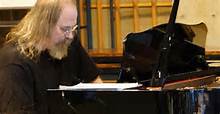
For the concerto, he contributed his own cadenzas to the first and third movements. The first one reached out technically with some adept cross-hands passages, interpretively with keen but never overstated major-minor interplay. For the finale, he made a cascading start and steady progress toward a shiny virtuosity that gave bravura sweep to the concluding measures, after which the soloist raised his hands (see photo) like a victorious athlete.
The concert opened with a bright account of Mendelssohn's Overture to "A Midsummer Night's Dream." The woodland spirits were nimbly evoked several times as the composer also depicts the gambols of the two pairs of lovers and the adventures of the Athenian tradesmen, specifically Bottom when transformed and braying like a donkey. Kraemer elicited a clever, tender performance right through a final benediction uttered by the flutes.
Further display of ICO members in solo work and in combination came in the second half. There were two marvelous suites, on "Love's Labour's Lost" by Englishman Gerald Finzi and "Much Ado About Nothing" by Erich Korngold, a Viennese wunderkind who escaped the Nazi plague to America and forged a successful second career, mainly as a film composer. His pre-exile music to an Austrian production of Shakespeare's feisty romantic comedy shows gifts for melody and ensemble color, including touches of individuality divided among a plethora of players. with particular eloquence coming from cellist Marjorie Lange Hanna.
Similarly, there were virtuoso turns aplenty in Finzi's music for one of Shakespeare's richest exercises in wordplay. The scherzo depicting Moth, the punning page, was particularly delightful. Among the zestful, characteristic solos were those played by Eli Eban, clarinet; Kara M. Stolle, bassoon, and Csaba Erdelyi, viola.
It's too bad more elaborate program notes for the pieces in the second half couldn't have primed the audience's ears for just what the two composers intended to depict in instrumental terms. Even so, the ICO's well-prepared exposure to both the Finzi and the Korngold offered hearty justifications for the theme of Shakespeare and love.


Comments
Post a Comment