Headed for America, headed from America: Pacifica Quartet returns to EMS series
 |
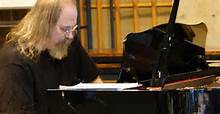
| Relaxed Pacifica: Vamos, Ganatra, Holloway, Hartman |
The last time I heard the Pacifica Quartet on the Ensemble Music Society schedule (March 2021), the caution everyone was feeling at the height of the pandemic made live-stream exposure advisable. But the quartet's excellence was already well-known to me via its CD series, "The Soviet Experience." And its stature among local music-lovers was carved in stone with its live participation in the chamber-music phase of the 2017 American Piano Awards.
With a few personnel changes (in second violin and viola chairs) since its founding 32 years ago, this ensemble has been prolific both in the recording studio and on the concert stage. First violinist Simin Ganatra and cellist Brandon Vamos are the mainstays; the current roster is filled out by second violinist Austin Hartman and violist Mark Holloway.
EMS Indianapolis has pitched its tent for the 2026-27 season on the United States' 250th anniversary this year, celebrated officially last July 4 under the shadow of deep political divisions. Regardless, and setting doubts aside, who can resist touches of musical Americana, whether they show up among the native-born (Charles Ives), distinguished visitors (Antonin Dvorak), or immigrants forging new careers on these shores (Erich Korngold)?
Wednesday's concert at the Indiana History Center indeed proved irresistible, right through the encore, a near-tear-jerker as the string-orchestra showcase "Adagio for Strings," and much more impactful in its original, intimate form as the slow movement of Samuel Barber's String Quartet in B minor, op. 11.
The Pacifica opened its program with a piece likely to have more hints of familiarity than the explicit ear-worm status of Barber's greatest hit. Charles Ives wrote his String Quartet No. 1 when he was just past his student days at Yale, reflecting his background in church music more than the modernism he was soon to pioneer in an eccentric manner. The EMS program book brackets the four-movement work with the title "From the Salvation Army," but it's also known as "A Revival Service." The score exercises Ives' fondness for hymns well-known to New England Protestants at the turn of the last century.
The Pacifica's performance leaned into the melodies that Ives celebrates in the score ("From Greenland's Icy Mountains" in the first movement, "Stand Up, Stand Up for Jesus" in the finale), woven among his nascent adventurousness with conventional harmonies and a pliable flair for counterpoint. And isn't that "There's a Wideness in God's Mercy" recalled in the third movement? Many of us have such touchstones in our memories, and Ives puts a personal stamp upon his.
With the Korngold quartet (No. 2 in E-flat), the capacity audience was exposed to a more developed capacity for emotional impact and dramatic pacing that the Austrian emigre was to exhibit in his adopted homeland as a composer for movies. (Ronald Reagan is said to have considered his performance in "Kings Row," scored by Korngold, as his best.)
There are modernist touches in the first movement, but Korngold was explicit about departing from the innovations of his colleague Arnold Schoenberg. I found the comic-opera suggestions of the second movement delightful. The third movement evoked in my mind the quip often made about Korngold's violin concerto that it contains "more corn than gold." The finale was a spirited waltz, to the manner born, of course: it features those teasing, hesitant phrases before the return to the dancing momentum of the main material, the kind that symphony audiences enjoy in Richard Strauss's "Rosenkavalier" Suite.
After intermission came the openness to the American experience that Dvorak displayed in two periods of residency here, most crucially in Spillville, Iowa. The Scherzo exploits as a motif something the Bohemian composer picked up from the song of the scarlet tanager, and the Pacifica had fun with the avian reminder that generated love-hate ambivalence in Dvorak. I was struck by the depth of feeling displayed by the ensemble in the "Lento" movement, especially in the exquisitely poised ending.
To wrap up the printed program, in the finale the much-admired visiting ensemble displayed both finesse amid motoric energy, particularly raising the excitement with spine-tingling chromatic lines cascading toward the end. All four composers represented in this concert, whatever their connections to this country, knew how to write music that plunges to the American heart.


Comments
Post a Comment