In an ideal acoustic environment befitting his majestic recital Yefim Bronfman performs in Carmel
It's not deliberately quirky to focus on the most modest piece in the
 |
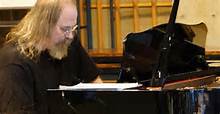
| Yefim Bronfman was last hereabouts with the Indianapolis Symphony Orchestra. |
program Yefim Bronfman offered Friday night at the Payne & Mencias Palladium, despite its thundering companion on the second half of the pianist's solo recital, Beethoven's "Appassionata" Sonata, op. 57.
That's because Robert Schumann's "Arabesque," op. 18, displayed the recitalist's deliberately understated lyrical gift. The profile of melodic inspiration here and throughout the recital was vivid without excessive insistence.
In "Arabesque," there was steady attention to gathering forces, sunny though they are in expressing what has been called the Eusebius side of the composer's character. It's as if Bronfman was sensitive to a borderline bipolar personality collecting his thoughts even in miniature and displaying Schumann's artistic integrity at its best.
This whole-picture focus was carried through in everything Bronfman played here. His opening set of pieces, Four Impromptus, op. 90, by Franz Schubert, gave him expanse to convey his breadth of skills. The echoing phrases so characteristic of this composer's leisurely treatment of his material had substance.
Nothing seemed secondary in importance, as filler or padding. The flowing character of the second impromptu, for example, generated naturally the vigor of a second theme. There was an unimpeachable integrity to the performance. In the fourth piece, the minor episode with tremolos was especially picturesque, even though this is abstract music focused on charm.
The same was evident in the Schubert/Liszt "Ave Maria." Bronfman presented a full picture of the familiar melody, treated as worth Liszt's elaboration at every point. For elaboration of a more pixieish cast, Liszt's Etude in E-flat was a delightful reminder of the original, Paganini's Caprice No. 17, familiar over many years in performances at the International Violin Competition of Indianapolis.
The crowning masterwork was the Beethoven "Appassionata," opus 57 in F minor. Contrasts of texture and dynamics were prominent in the first movement, all under Bronfman's exquisite control. A judicious balance of question and answer, with none of the answers settled, marked the slow movement.
In prose of less equanimity than usual, the eminent musical analyst D.F. Tovey once cited "that precipitous change of moods which continues throughout the mighty proportions of this piece." Tovey then details the range of human emotions seemingly caught in an inescapable hell; another commentator calls it "music reminiscent of the Inferno visions of Dante's fancy." In Bronfman's performance, the enunciations of doom, and resistance to it, climaxed in the coda of the finale, in which bass accents amounted to Jovian thunderbolts given cosmic significance.
Bronfman's deft programming and encore selection, so apt when he was the Indianapolis Symphony Orchestra's guest eight years ago and followed the Beethoven C minor concerto with Debussy's balm-shedding "Claire de Lune," was at work here. Responding to a hearty, shouting ovation, the recitalist told the audience: "Tchaikovsky wrote a piece called 'October.' I'd better play it now since it's almost November."
Indeed, he drew upon the Russian composer's tender melancholy, so much more resigned and accepting than Beethoven's raging counterstatements, for the excerpt from "The Seasons" titled "Autumn Song." This native of Tashkent was sharing some of the pathos of his homeland's music, bidding farewell with the glowing touch that had saturated the music on the printed program.


Comments
Post a Comment