The way of Tao: Two distinctive personalities are ISO guest artists this weekend
There was no riotous behavior in Friday night's Indianapolis Symphony Orchestra concert, despite a guest conductor's hearty hailing of what seemed to him to be "a party audience," and ending his brief remarks before the concert's second half with the invitation to "throw things or whatever."
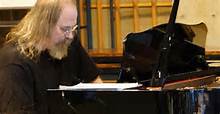
 |
| Richard Egarr is making his ISO debut. |
Richard Egarr, principal guest conductor of the Residentie Orkest in the Hague, Netherlands, is sharing the stage this weekend with another guest artist who presents himself in unusual fashion: pianist-composer Conrad Tao. The Illinois native invited no rowdiness, but he proved to be a lively attraction to an enthusiastic, rather small audience at the final Classical Series concert of 2026 in Hilbert Circle Theatre.
Tao performed with intense focus on the task at hand, whether it was his own composition "The Hand" or the work that inspired it, Beethoven's Piano Concerto No. 1 in C major, op. 15. His concert attire has a unique freedom from convention, however, as a quick search online will reveal. On Friday there were large underarm holes in the sides of his jacket; underneath was a sleeveless black T-shirt. It made for a distinctive kind of formality that looked adjacent to casual wear without crossing the line.
The "whatever" response to Egarr's injunction to the audience took the form of enthusiastic applause, swelling between movements of the concerto, but notably respectful while the music was played. There were whoops and cheers in the pauses. Then Egarr directed the orchestra to share his gratitude by signaling deep ensemble bows to acknowledge the ovation.
His batonless conducting of Mozart's Symphony No. 39 in E-flat, K. 543, had an easy yet specific level of command. He was attentive to the music's contrasts in dynamics and levels of intensity. The graceful slow movement, Andante con moto, was consistently laid out in nesting phrases; everything fitted into place. The minuet movement that followed was too fast, but not so much as to sacrifice articulation. The finale followed with more conventional briskness and enough hints of the dramatic to remind us that Mozart was a master of the stage and the characters his librettists provided for him.
 |
| Conrad Tao applies his individualism to composition too. |
Opening the program is Tao's 2024 work for piano and full orchestra. It carries the forthright title "The Hand." The reference is to the busy hand of the composer who sketched his compositions in detail, often leaving a jumble of hastily penned and scratched-out notes.
Both Tao's composition and some of his emphases in the concerto revealed his fondness for the bass register. His contrasts of bass and treble in the finale, especially in transitional passages, were charming throughout. His songful manner in the slow movement was nicely set against lovely work by principal clarinetist Julianna Darby.
"The Hand" opens with a rumble deep in the keyboard, staying there while the orchestra contributes color and density. Some vigorous pizzicato playing by the strings and recurrent splashes of percussion evoked Beethoven's penchant for subito rises in volume. A lengthy episode of tender playing yielded to some piano octaves and chorale-like brass writing before a calculated diminuendo led to a subdued ending. As a whole, "The Hand" reflected the twinned vehemence of Beethoven's penmanship and creative struggle while not ignoring his hard-won mastery of lyricism.
Called back to the stage several times, Tao obliged with an encore, his transcription of Art Tatum's elaborate 1953 version of "Over the Rainbow." The jazz pianist famously excited the admiration of Vladimir Horowitz in that same decade, and in Tao's performance of this beloved standard it was easy to see why.



Comments
Post a Comment