Adaptable across the repertoire, Hamelin displays his Mozart affinity with Orpheus
Marc-Andre Hamelin doesn't impose his personality on a variety of music so as to build a cult following.
This is unlike old Hollywood stars, who molded each role onto their public personalities and built their careers on offering the best new version of their marketed presentation, like John Wayne or Cary Grant or Katharine Hepburn.
This is unlike old Hollywood stars, who molded each role onto their public personalities and built their careers on offering the best new version of their marketed presentation, like John Wayne or Cary Grant or Katharine Hepburn.
But a personality need not be irrelevant or a distraction if the effort to probe deeply into a composer is sustained: the composer is revealed along with the individuality of the performer, and Hamelin does that to the level of wizardry.
The main vehicle was a Mozart concerto just below the level of the most celebrated later works, the Concerto in A major, K. 414. The acoustical environment of the Payne & Mencias Palladium suited the piece; the sound was somewhat dry but well-knit. Imitative phrases were articulated the same by the solo instrument and its accompaniment.
Thus a Debussy prelude as an encore has a veiled charm that the pianist seemed to view from the inside out, as though inhabiting the colorations and the linked, unsquare phrasing characteristic of the French composer. The demand to hear more, enthusiastically generated by the Orpheus Chamber Orchestra with whom he came to Carmel Saturday night, shed that kind of light.
 |
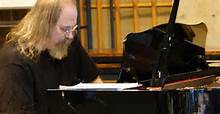
| Marc-Andre Hamelin played Mozart with inside knowledge. |
Orpheus, formed as a conductorless ensemble and sustaining that arrangement for more than 50 years, is bound to lend a chamber-music feeling to a sensitive guest artist of Hamelin's caliber. That reputation, plus the pianist's own, drew a large audience to the Allied Solutions Center for the Performing Arts. Hamelin's ornamentation of repeated phrases was deft, tasteful. The partnership was especially well projected in the way the orchesetra underlined the spirit established by the buoyant piano in the finale.
Dynamic variety under the orchestra's collective control was readily evident in the opening work, an arrangement of the Allegretto movement of Beethoven's "Tempest" Sonata (no. 17 in D minor). Three wind players (horn, clarinet, bassoon) supplemented the main body of strings.
Those players returned for the sole work on the program after intermission, an arrangement of Schubert's Piano Sonata in B-flat, D. 960. This sometimes grandiose, often intimate final work by the short-lived Austrian composer was a perfect display of the Orpheus Chamber Orchestra's range of excellence. It soars, it whispers, it plunges dramatically. Typically, there was altered seating with a different concertmaster. There are no back-benchers in Orpheus.
The wind instruments had many moments of display, always placed in context well. In the first movement, the melodious contribution of the clarinet in this settting no doubt reminded many Schubert fans in the audience of "The Shepherd on the Rock," a beloved song in which clarinet has a starring role alongside soprano and piano.
The arrangement had a zesty call-and-response feeling in the Scherzo, with the three winds shining in a soft-spoken manner in the Trio. The finale gave the horn a characteristic signaling function, a touch of color that the solo piano can only suggest. All told, it was easy to set aside the original brilliance of piano alone and get the impression of a "chamber symphony," as Heribert Breuer properly titled his arrangement.


Comments
Post a Comment