The quirky genius of the Marsalis family leads his quartet at the Palladium
"Howdy!" is the one-word greeting Branford Marsalis offered to the large crowd gathered to hear his quartet Friday night at the Payne & Mencias Palladium.
He may have dropped the salute as something implicitly Hoosier, but it would be hard to interpret it as looking down his nose at us. Neither effusive nor tight-lipped in his commentary, the veteran saxophonist showed the friendly demeanor that has always contrasted with the lecturing stance of trumpeter Wynton, the other household name among the distinguished New Orleans musical family.
He led one long set at the Allied Solutions Center for the Performing Arts jazz series, fronting a long-
 |
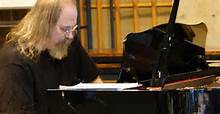
| Branford Marsalis Quartet: By the third number, the jackets were off. |
intact group including Joey Calderazzo, piano; Eric Revis, bass, and Justin Faulkner, drums. Early in the performance came two catchy originals by Calderazzo, "Conversation Among the Ruins" and "The Mighty Sword." In between there was a zesty neo-funk piece by Keith Jarrett, "As Long As You're Living Yours."
Marsalis favored the soprano sax in launching the concert. He has one of the purest, serenely floating tones on that instrument of any jazzman specializing in it. Solos in the upper register show him capable of a perpetual-motion flow of ideas. By "The Mighty Sword," Faulkner had revealed his gifts as a percussion colorist at a level matching the leader's command of nuance.
And Marsalis' characteristic wittiness was approached creditably by Revis in his solo on the old chestnut, 'There Ain't No Sweet Man Worth the Salt of My Tears." The bassist's solo had the defiant exuberance, tonal plumpness, and some of the sheer dexterity of the iconic Charles Mingus, complete with that master's vocal interjections. Marsalis had switched to tenor, his tone still pure but suggesting the saltiness in the title. Faulkner's solo started softly and acquired a strutting stature.
Then it was time to get into the Great American Songbook proper at a venue that's home to a foundation honoring that repertoire. I was reminded of the time Marsalis told me in an interview that he didn't pay much attention to the lyrics of such songs when he went about interpreting the music. "Yeah, my father thinks that's important," he shruggingly said of his father Ellis, a pianist-educator who was still active at the time we spoke. One famous saxophonist of his father's era (I forget who), once cut his solo short with the explanation: "I forgot the words."
None of that for Branford Marsalis, yet I have to believe he's familiar with the texts of "Stardust" and "Cheek to Cheek," though maybe not word for word. He played those tunes with such affection that their verbal meaning seemed to be embodied in how he treated them. But particularly in the case of the Irving Berlin classic, he must have a kind of "free fantasy" approach, where the texts definitely can't be applied to his extrapolations of the original. This kind of composition was popular in the romantic era, particularly Franz Liszt's adaptations of opera tunes for solo piano.
The saxophonist shoots way beyond paraphrase (as is clear from his version of "Cheek to Cheek" on the 1999 CD "Contemporary Jazz"), following some of the phrase shapes and rhythmic profile of the original while ranging free. Calderazzo shows an affinity for such freedom as well: his solo on "Cheek to Cheek" seemed to drift from time to time, but was always pulled back onto solid ground that somehow honored Irving Berlin.
A tumultuous ovation prompted the quartet's return for an encore, in which the members were joined by Todd Williams, a past colleague of Wynton and his groups. Everybody reveled in the offhand verve of Thelonious Monk's "Well You Needn't," both saxophonists soloing heartily.


Comments
Post a Comment