Mitzi Westra guides a stylish tour through art song in Romance languages
 |
| Mitzi Westra's performances are well-remembered. |
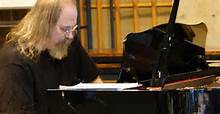
"Romance Languages" was the rubric under which selections of Italian, Portuguese, French, and Italian art songs were artfully placed with spoken introductions emphasizing the diction challenges in each of the four languages. The lecture element was succeeded by her enchanting interpretations, accompanied insightfully by Elisabeth Hoegberg, piano, in Ruth Lilly Performance Hall, Christel DeHaan Fine Arts Center.
I have long been pleased to attend Westra's performances, usually in context with other singers, and significantly in such crowd favorites as Handel's "Messiah." The way she put across such alto arias as "He was despised" and "O Thou, That Tellest Good Tidings to Zion" alone has provided sufficient indication of her emotional and technical investment in music ranging from sorrow to joy. In short, it would be tiresome to recapitulate here all the times I've been charmed by her artistry.
In particular, I looked forward to hearing "Chansons de Bilitis," Debussy's setting of three prose-poems by Pierre Louys. The poet maintained for a while that the texts were translations from a contemporary of Sappho, whose life spanned the seventh and sixth centuries BCE.
But Louys later admitted his authorship, a retracted deception that's reminiscent of violinist Fritz Kreisler's claim that he'd discovered 18th-century pieces he later acknowledged as a hoax. He meant to assure their adoption in performance by other violinists not willing to showcase a rival openly. (That worked, much to the annoyance of some duped critics.)
But back to Debussy's attraction to these texts. I can't resist quoting the distinguished 20th-century critic Oscar Thompson, who wrote that "Chansons de Bilitis" "must be regarded as among the ripest fruits of an art at once sensitive and voluptuous, reticent and sybaritic." You said a mouthful, Oscar, and Monday's performance justified all those adjectives.
It's of a piece with the interest of French composers in the mythology of the ancient world, including not only Debussy, but significantly Ravel in his "Daphnis and Chloe," a beloved score especially in its orchestral suites. Visual artists in 19th-century France also had an intense interest in the stories, characters and atmosphere of classical Greece and Rome.
The dream of a pan-pipe gift from a lover animates the first song, "La Flute de Pan." The other two songs proceed from that sylvan enchantment through the gentle eroticism of a meeting to the magic conferred upon the subject by the water nymphs known as naiads, even at their tomb.
The Westra-Hoegberg partnership sounded exquisite in this set and elsewhere. In "The Tresses," the piano anticipates the rise in dynamics of the voice, such that the mystical love affair becomes a matter of firm bonding. Especially eloquent was the end of that song, where the singer's "I cast down my eyes and trembled," presents a mood reinforced by a few irresolute Debussyan chords leading to a pure consonance in the piano.
Westra's tone of finality in "Le Tombeau des Naiades," when the lover announces the death of the satyrs and nymphs, made something profound out of what could easily be taken as toying with imaginary figures from a dead legend.
It's hard to do honor to the variety of the rest of the program and its range of composers, but I will mention the enlightenment I felt privy to with a set of songs in Portuguese. Westra herself had been enlightened on rendering the texts properly by UIndy choir director Caio Lopes, a Brazilian musician now based in Bloomington, to whom she gave enthusiastic credit.
It's also worth mentioning the other integral set of songs, representing one composer of modern significance, the Argentine master Alberto Ginastera. Concluding the recital, his "Five Popular Argentinian Songs" provided an example in variety of articulation and accompaniment styles of the result whenever he nestled his modernist inclinations in the rhythms and vivacious melodies of his folk heritage.
I was impressed by the controlled outburst the singer made in "Triste" on the lines (in translation here) "I gave up my heart to one who did not deserve it" and "But sadder still is to love with no hope at all." The agonized passion of countless songs of love gone wrong seemed encapsulated there. It helped also that Westra's upper register took on more bloom as the recital went on. Hoegberg's accompanying was built on a solid foundation as well, ready to ascend to the humorous cacophony of a song celebrating lively cats and girls.


Comments
Post a Comment