Indianapolis Baroque Orchestra's 'Towards Telemann" sketches in the background of a sophisticated composer
 |
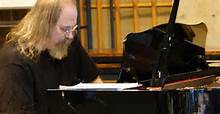
| Barthold Kuijken, conductor and traverso soloist |
If there is plenty of evidence that progress in the musical flowering called the High Baroque can be justly considered "Towards Telemann," as Indianapolis Baroque Orchestra's concert Sunday was titled, a host of influences he absorbed must have been responsible.
That was explored fruitfully in the program put together and led by its artistic director, Barthold Kuijken, at the University of Indianapolis.
Georg Philipp Telemann's breadth of musical creation was fed by his receptivity to French, Italian, and German styles, types of patronage, and modes of expression. His appeal to his contemporaries and shortly after his time (1681-1767) was straightforward and broadly based, thanks to a succession of courtly appointments that made him more widely known than his contemporary, J.S. Bach. And the theater bug bit him as well.
His work as an impresario and composer of opera helped, giving him a reputation for facility and more secular dilution of his genius than the lofty stature conferred upon Bach in the early 19th century. As the entry in "The New Grove Dictionary" concisely puts it: "A Kantor [Lutheran institutional music director] who had written operas came to be looked down on as a merely 'fashionable' composer lacking in religious fervor."
Before Telemann got exposure in this concert, there was plenty of opportunity to savor the signs of the stage's influence upon him. In a concert-opening suite by Jean-Baptiste Lully, a march for the entrance of Polyphemus, a secondary character in the opera "Acis and Galatea," made concise points with its dark instrumental colors and crisp character delineation.
Reflective of the classical influences upon baroque art, the work (whose more famous counterpart is Handel's opera on the same subject) relates by implication to the wider world of Telemann's artistic production. The orchestra's balance of forces maintained clarity throughout the suite, with the wall curtains raised high in the Ruth Lilly Performance Hall for acoustical benefit. Pairs of of flutes and oboes had their distinctive say against the strings (plus harpsichord and bassoon for harmonic grounding).
Literary classics generated such works as perennnially popular treatments of Orpheus' sojourn in the underworld — in this case a mini-opera within a more complicated story (as Matthew Balensuela's informative program notes indicate) set by Andre Campra at the turn of the 18th century. It was clear that baroque opera expanded the role of instrumental color that eventually allowed purely instrumental music self-sufficient status and opportunities for textural contrast. The way the violas crowned the presto conclusion of an aria from the intermezzo of "Orfeo negli Inferni" gave succinct confirmation of that development.
Telemann's most eminent "towards" figure on this program — his near-contemporary Antonio Vivaldi — gave the winds a rest and displayed the Red Priest's ingenious deployment of sequences, imitative phrases used as building blocks in flowing unanimity. The work was the Sinfonia from "L'Incoronazione di Dario."
That set up a climactic exhibition of Telemann's Flute Concerto in D, with Kuijken as traverso soloist — a role in which he made his reputation decades ago. At fast or slow tempos, his tone displayed firm support over well-balanced phrasing. The Largo had an appealing manner in phrases that droop only to reach up at the end. The gigue tempo of the final Allegro was heartening and lively from solo instrument and ensemble alike.
Kuijken turned back to conducting in a revelatory Suite in E by Telemann. It gave symmetry to the concert, harking back to Lully as it relied on French dance forms as well as the structural norm of the '"Ouverture," with its precise dotted rhythms and tension switching from slow to fast. For sheer international bravura the work ends with a Hornpipe, a strongly accented English sailors' dance. The audience was sent out into the harbinger of spring sunshine refreshed.


Comments
Post a Comment