The pleasure of programming: ISO gets a visit from Angela Brown
 |
| Angela Brown, soprano from Indianapolis |
Some of that is intact this weekend as the Indianapolis Symphony Orchestra's Classical Series resumes at Hilbert Circle Theatre. The orchestra's first of two full-length concerts had an overture by a mainstream composer to start with and a symphony by a master to conclude.
To help support the overall feeling of novelty, the overture was the largely unfamiliar one to Weber's opera "Euryanthe," a poster child of good composition let down by a poor libretto. The symphony was the easy-to-overlook No. 8 in F major by Beethoven, a work memorably characterized by Schumann as "a slender Greek maiden between two Norse giants" (the seventh and ninth symphonies).
The real novelty was three first-time performances by the ISO, one of them a world premiere: "Phenomenal Queen: Coretta Scott King," by James Lee III. It's an idealistic solo cantata focusing on Martin Luther King Jr.'s wife and, following his assassination in 1968, longtime widow and symbol of the civil-rights movement he had been at the forefront of.
Lee's music occupies a wide spectrum suitable to the theme of personal challenges and ambitions, with the long curve of its universe bending toward "the beloved community." Only in abstract terms is it a portrait of Coretta Scott King. This moves the work to the high plane the vision Coretta shared with her husband. Having been an aspiring singer, she makes a fitting subject for a piece focusing on Angela Brown, the soprano soloist. With guest conductor Anthony Parnther showing ready sympathy with the text, which the composer devised from several sources, and his supple music, "Phenomenal Queen" was bound to make a hit with a public already well-disposed to this local soloist.
Brown's voice seems to have lost some flexibility with age, and her diction was sometimes vague: It could be readily compared with the texts projected on a screen above the stage. The brilliance has remained on the whole, however, and it was complemented by the singer's flowing, queen-like garb, which might best be summed up in the technical term "jaw-dropping." The soprano returned to the stage after intermission to sing Brahms' stirring song "Geistliches Wiegenlied" with the orchestra and its principal violist, Yu Jin. The accompaniment was devised from the piano part by ISO librarian James Norman, making it another world premiere.
 |
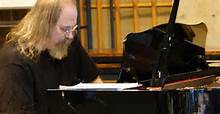
| Yu Jin has been ISO principal violist since 2017 |
and tenderness of the vocal soloist. What a fine inspiration to have a short piece at hand to bring two soloists together in the same program!
Jin gets a starring solo role in a contemporary Chinese piece, "Xian Shi," by Chen Yi. A viola concerto of apparently unique difficulty, Parnther told Friday's audience in introducing it, the work ranges across the viola's expressive terrain. The different character it has as the middle member of the string family is fully embraced in a work that draws upon Chinese instrumental timbres.
The violist's facility in double-stopping at varying speeds and levels of intensity was remarkable in Friday's performance. When called for, the viola's lyrical quality was equally brought to the forefront. The orchestra's role is a riot of tone colors and rhythms; the ISO played for its first-chair colleague with evident commitment and unflagging zeal.

Anthony Parnther, guest conductor
The major piece on the program, on the short side of Beethoven's later symphonies, amounted to great confirmation of the guest conductor's skill at forging a coherent interpretation of a piece that can sound simply odd among its mighty fellows. Schumann's image of a slender Greek maiden seems a little distant, after all. Parnther summed up the work as "equal parts joy and mischief.... Let's have fun with this!" he urged the audience.
So it seemed everyone did. The plunge directly into the theme in the first movement came off rather blurry Friday night, but quickly everything jelled. The second movement, "Allegretto scherzando," famous from the time the symphony was new for imitating the new device of the metronome, sounded as droll as I've ever heard it. The end of the movement was indeed, as Antony Hopkins has described it, "sheer Walt Disney."
The whole piece exemplifies how much of a virtuoso Beethoven could be when a light mood struck him, as it rarely did. In person his sense of humor could be coarse; when he was about his work, it was as much a part of his genius as ever, both innovative and under control. This performance, apart from that slightly scattered opening, was a trim exhibition of his mastery. It was also a fine display of the dash and precision of the ISO in its present condition, whether under the baton of its music director or a capable guest maestro.


Comments
Post a Comment