Wrestling with eastern Europe: IVCI laureate Shannon Lee in duo violin-piano recital, no holds barred
 |
| Shannon Lee impressed the IVCI jury in 2018. |
For five years, the Canadian violinist has been collaborating with Russian-born pianist Arseniy Gusev. That's included two recordings that were reflected in the program they offered at the Indiana History Center.
Composers have long emphasized equality between the two instruments in bringing their respective techniques and modes of expression into partnership. Works for violin and piano, many of them sonatas, abound in the repertoire.
It was like catnip to the acknowledged master Elliott Carter, an explorer of oppositions in music who found the instruments' physical differences — "between stroking and striking," as he put it — a delectable challenge in creating "Duo" in 1973.
 |
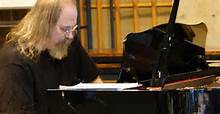
| Arseniy Gusev: Byronic pose, chiaroscuro light |
In Gusev's "Crossroads," which he premiered with Lee in 2024, the two instruments' common purpose is curated from the start. Individuality is subsumed into a jointly undertaken challenge. Points of repose are few, and Tuesday night found both performers fully fluent in the composer's idiom.
It's described by Gusev almost in programmatic terms as a hero's journey through the underworld, emerging into light at last. Violin and piano make the struggle together. The nine short sections balance on the fifth, a voice de profundis.
Along the way down and back, much of the reaching across any physical gaps between the two instruments is the pianist's responsibility. With one hand reaching inside, there are "matte" surfaces on many of the piano's notes, in which the striking quality of the instrument is not allowed resonance, but muted. There are also notes plucked harplike on the inside of the instrument. There's thus striking and stroking going both ways.
Gussev's large-gestured performing manner understandably complemented what he has set down on the page as "Crossroads"' creator. Lee's intensity was more self-contained, but never flagging or in doubt.
The concert concluded with a more straightforward duo, Sonata for Violin and Piano by Sergei Slonimsky, who taught Gusev in his home country, the Soviet Union. The work is bookended by two fast movements, the finale inflected by the explicit direction "furioso." The slow second movement provides a welcome respite from the compact energies released before and after it. (The composer may be best known by name here thanks to his uncle, expatriate Nicolas Slonimsky, editor of a delightfully spicy anthology, "Lexicon of Musical Invective," and author of one of the best musician memoirs, "Perfect Pitch.")
The concert's first half established the program's concentration on 20th-century music from eastern Europe. "Suite italienne" was sampled in three movements from Stravinsky's "Pulcinella" suite. The way the melody is shared by violin and piano in the middle movement, "Serenata," offered a capsule version of how well these two players work together. And the finale,"Tarantella," gave the first of the concert's many indications that the pianist could sound hard-driven without becoming mechanical.
The violinist's controlled harmonics were exquisite in the opening of Szymanowski's "Mythes," inspired by the Latin poet Ovid. "Narcisse," emanating from the well-known myth of the self-worshipping Narcissus (if he had known selfies, he would have invariably set the filter on "only me"), showed a remarkable depth of lyricism in the playing of both Lee and Gusev. The last movement, "Dryades et Pan," represented chase music at its most ethereal, and, in this performance, most believably authentic.
For modernism put forward as explicitly as precursor to Gusev's piece, "Partita" by Witold Lutoslawski (composer of the IVCI commssioned piece "Subito" in 1994) was also remarkable for a "Largo" in the middle position, where sostenuto playing with ornaments built up to a remarkable high plateau of tension. The concluding torrential "Presto" brought the performance up to intermission, whetting the appetite for "Crossroads."
At the very end of the program, the duo found the formula for balm with an encore, "Nocturne" by Nadia Boulanger.


Comments
Post a Comment